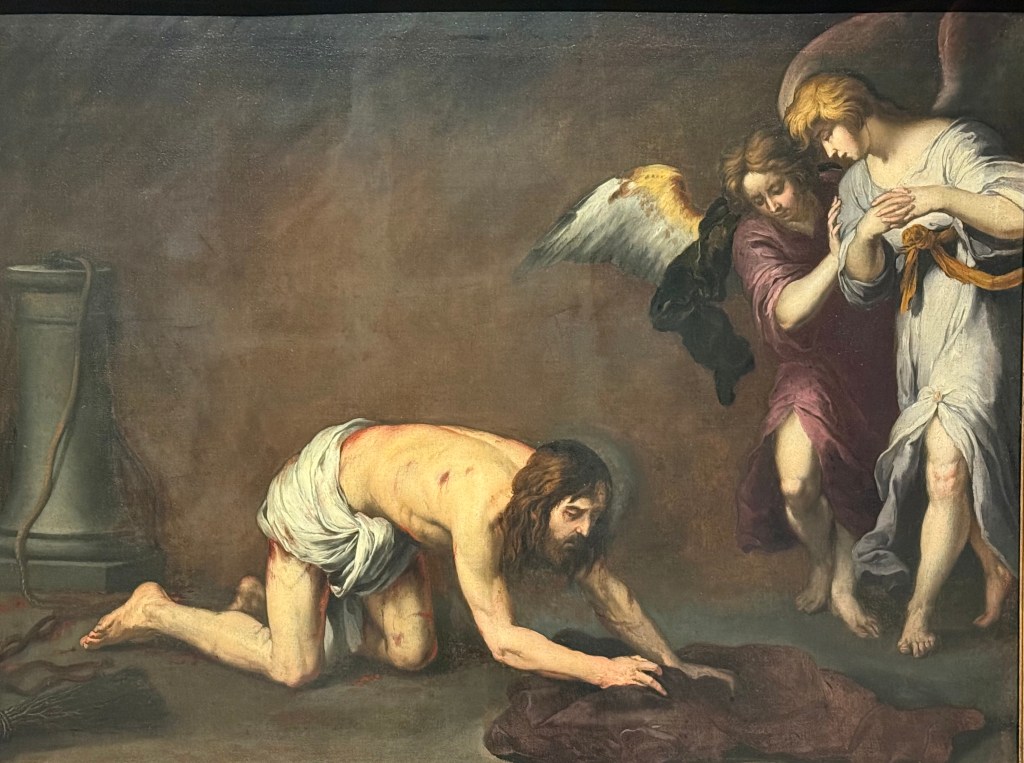
Christ after the flagellation

Bartolomé Esteban Murillo (1617-1682), Christ after the Flagellation, after 1665. Museum of Fine Arts Boston.

Today is the First Passion Sunday, when the season of Lent becomes more even sombre, as catholics leave the spiritual desert and prepare to accompany Jesus on his final journey to Jerusalem. The liturgy becomes starker and the statues and images in churches are covered by heavy purple drapes. Reflecting this mood I thought I would share this heart rending image of Christ after the flagellation by Bartolomé Esteban Murillo.

Murillo was known for his gentle and accessible religious images and for the sensuous beauty of his paint. Here he focused exclusively on Christ’s suffering, depicting his human yet divine nature. Christ’s tormentors have left the scene; Murillo placed him humbly upon the ground and painted his battered body so that his skin seems almost radiant, despite its wounds and sores. The adoring angels are present to elicit compassion and pity on the part of the viewer.
The last scholar of the ancient world

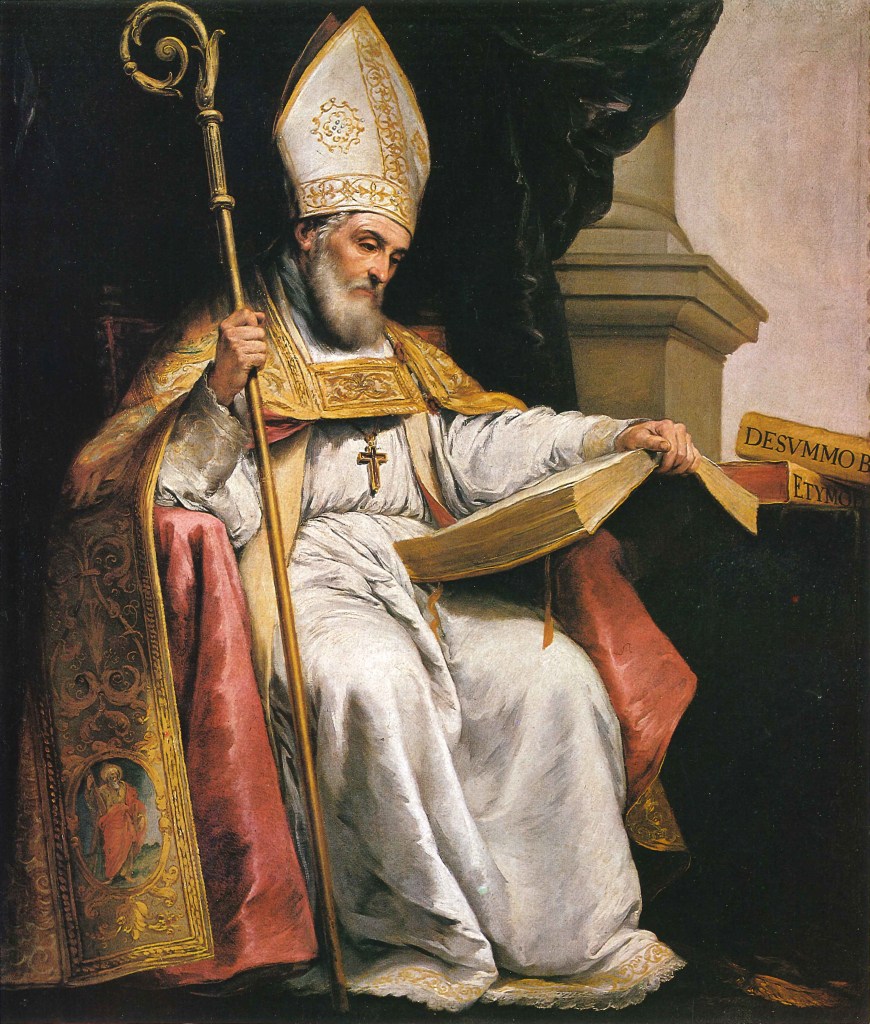
 Bartolomé Esteban Murillo, San Isidro, 1655. Pintura al óleo sobre lienzo, 193 x 165, la catedral de Sevilla.

Today is the Feast of Saint Isidore of Seville (c. 560 – 4 April 636) was a Hispano-Roman scholar, theologian, and archbishop of Seville. The Roman Martyrology tells us that he “shed lustre on his country by his zeal for the Catholic faith”, while the 19th-century historian Montalembert described him as “the last scholar of the ancient world”.

Isidore was the first Christian writer to try to compile a summa of universal knowledge, in his most important work, the Etymologiae. This encyclopaedia formed a huge compilation of 448 chapters in 20 volumes, and it is these books that Murillo depicts in this majestic image of the Saint, commissioned for Seville Cathedral by the Archdeacon of Carmona, Juan de Federigui in 1655.

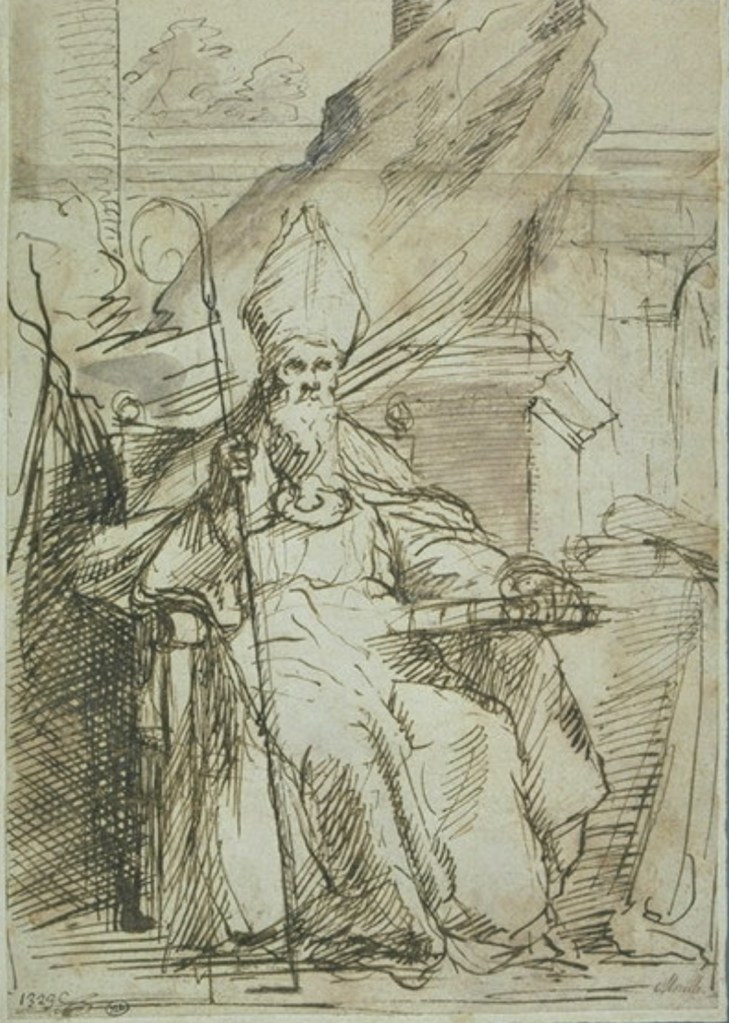
Bartolomé Esteban Murillo, San Isidro, 1655. Pen, ink and wash. Musee de Louvre.
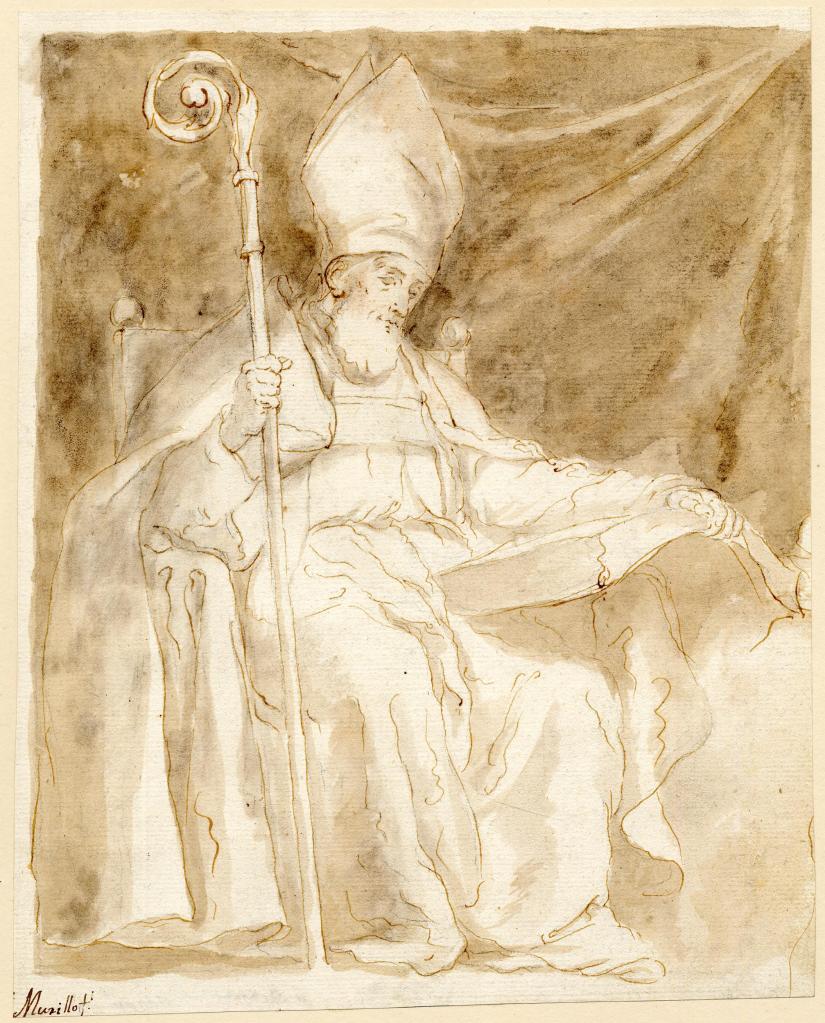
Bartolomé Esteban Murillo, San Isidro, 1655. Pen and brown ink, brown and grey wash over black chalk, The British Museum.

We are fortunate to also have these two preparatory drawings for the painting. The first in collection of the Louvre executed in pen, ink and wash shows the saint looking toward the viewer with a curtain, architectural details and book resting on a table behind. The second in the British Museum is executed predominately with wash and shows the saint exactly as he appears in the painting, reading the open book that rests on his knee. There are no background details other than a curtain. The changes expressed through these studies in different media offer a revealing insight into Murillo’s use of drawing as a means of working out his compositions.

Golden Age Abstraction

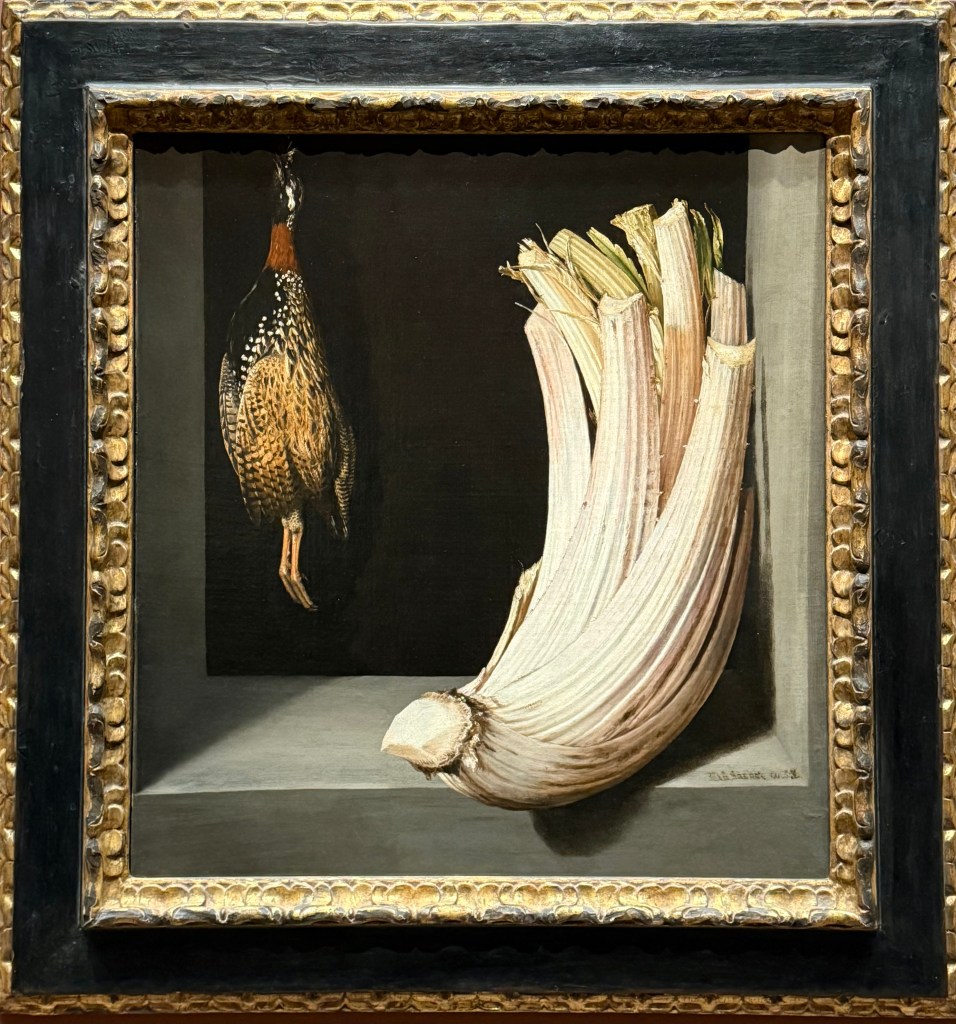
Juan Sánchez Cotán (1560-1627), Still Life with Cardoon and Francolin, 1603. National Gallery of Art, Washington D.C.

This is one of only seven securely attributed still-life paintings by the Spanish artist Juan Sánchez Cotán. Each one depicts food arranged in a dark, shallow niche. Balanced on the ledge is a curved cardoon, an edible plant related to the artichoke. Hanging on the wall is a type of game bird called a francolin.

Sánchez Cotán’s still life paintings appeared to cease after 1603, when he devoted himself to working at a Cistercian monastery in Granada. Four hundred years later, with the growth of abstract art in the 20th century, there is a renewed interest in the artist and his use of spare, geometric settings.

The Bassano Allegory of the Element Earth

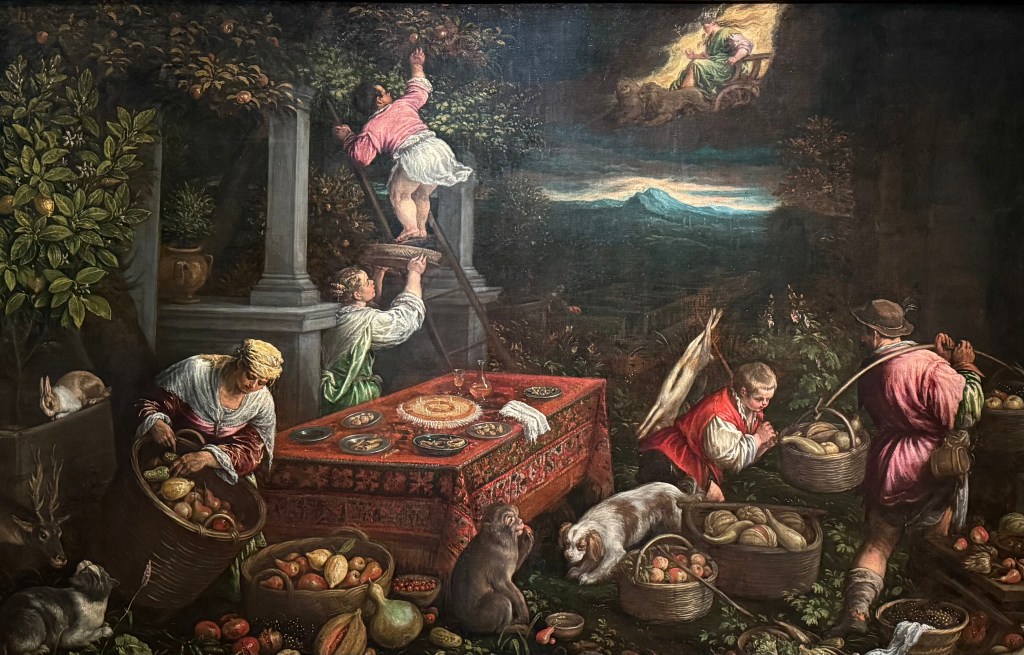
Leandro da Ponte, called Leandro Bassano (active 1557-1622), Allegory of the Element Earth, c.1580, Walter’s Art Museum, Baltimore.

In the l6th century, the world was believed to consist of four elements: Earth, Air, Fire, and Water. Here, Earth (associated with the season of autumn) is symbolized by the abundance of nature’s produce and by the small figure of Cybele, the ancient mother-goddess of earth and fertility, who rides across the sky in a chariot pulled by two lions.

This painting is an exact second version or copy painted in the studio by Leandro Bassano after a work by his father Jacopo (ca. 1510-92), who had produced a series of four paintings dedicated to the elements for a princely patron.

The skillful handling of the oil paint, the bold chiaroscuro (modeling in light and shade), and the emphasis on rich colours are characteristic of Venetian painting of the period. The Bassano painters were famous for filling their canvases with a wealth of natural details that were pleasing to the eye.

Juan de Flandres’s Annunciation

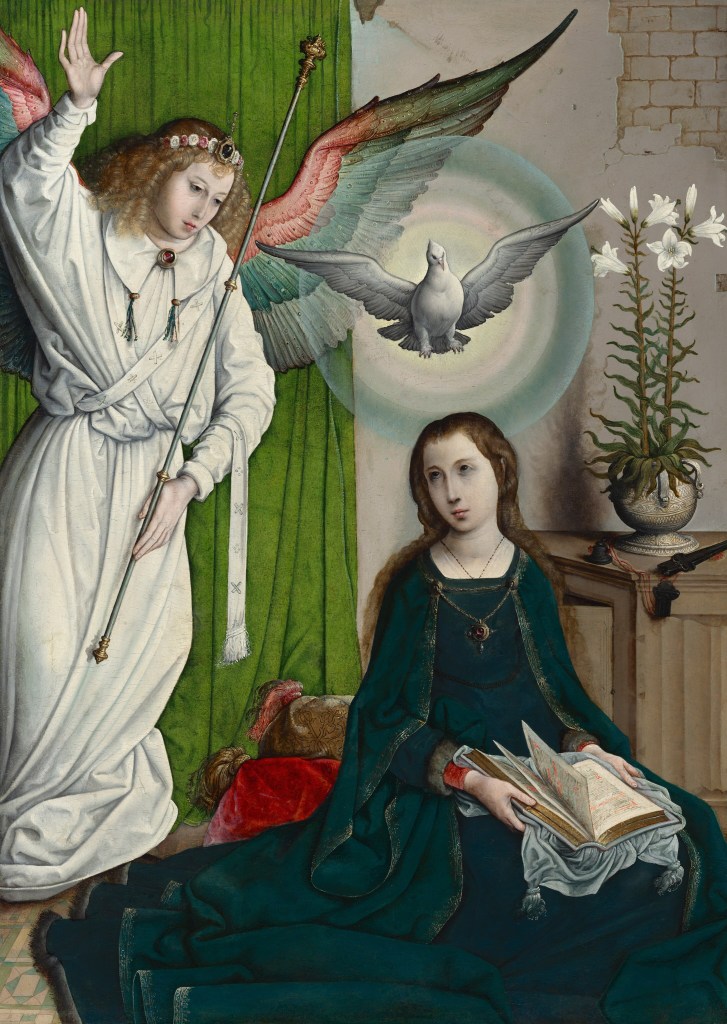
Juan de Flandes (active 1496-1519), The Annunciation, c. 1508/1519. National Gallery of Art, Washington DC.

For one day the penitential character of Lent is lightened with the celebration of the Feast of the Annunciation, the first great act of Salvation History.

In this crowded image of the event, by the Hispano-Flemish artist Juan de Flandres, the youthful Virgin sits on a crimson tasseled cushion, wearing a voluminous, long, royal-blue dress, her garment edged in fur and gold, an indication of her future Royal status. 

A winged angel stands looking at Mary with one arm raised as if in blessing, while in the other arm the angel holds a long, gold staff, a symbol of heavenly authority. Overshadowing the Virgin the Holy Spirit in the form of a white dove hovers with wings outstretched, surrounded by a white halo deepening in several concentric rings to aquamarine blue. The halo could belong to the dove or the Virgin, a physical sign of the union between God and humanity that it is at the heart of the annunciation message. 

Last, we see a bright emerald-green cloth hanging on the cream-white wall behind the angel, and brick shows through what appears to be lost plaster over the woman’s head to our right. The door of a cabinet behind the woman is ajar and a rounded urn holding tall, white lilies sits on the surface above. A rich symbolic passage demonstrating how the purity of Mary will overcome the decay of the human of the race.

Murillo’s Prodigal Son

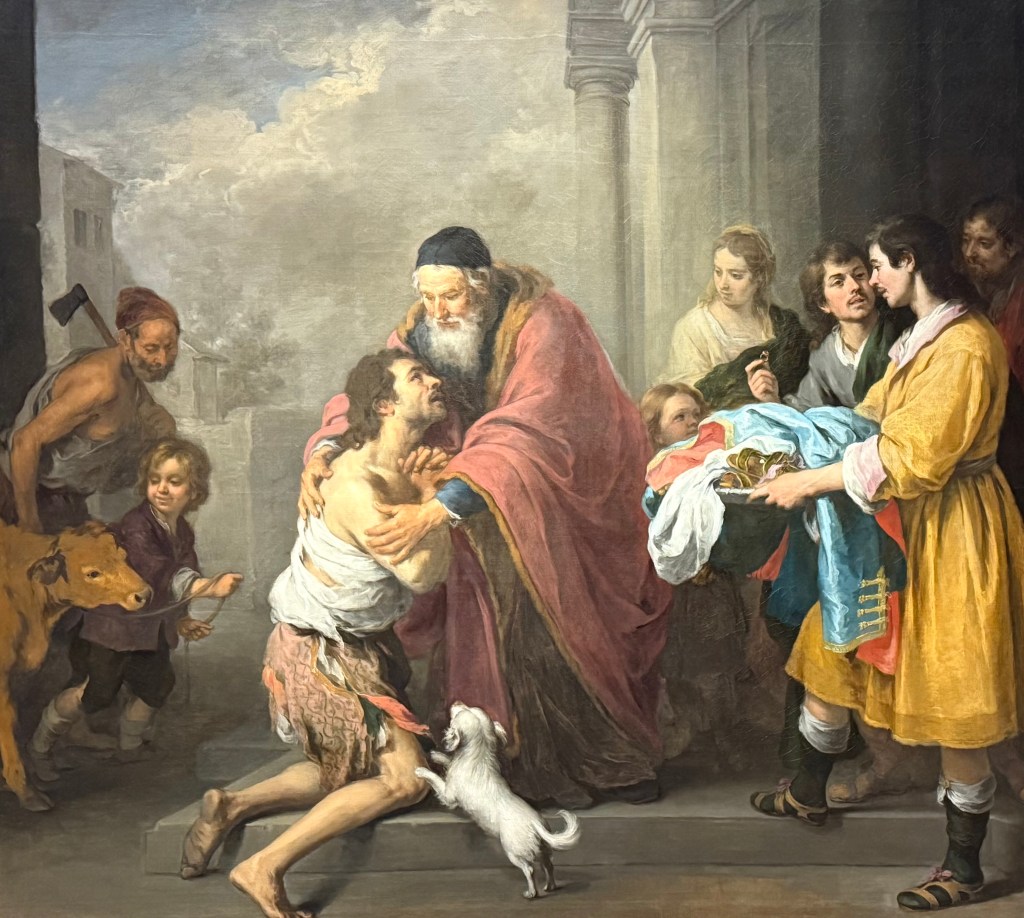
Bartolomé Esteban Murillo (1617 – 1682), The Return of the Prodigal Son, 1667/1670. The National Gallery of Art, Washington DC.

Murillo’s rendering of the parable of the prodigal son, taken from Luke’s Gospel (15:11-32) is surely one of the most tender and compelling illustrations of forgiveness and unconditional love. A younger son squanders his inheritance and having reached rock bottom returns home repentant, only to find himself welcomed home with joy in the warm embrace of his father, who immediately sends for new clothing and a fatted calf to celebrate this happy moment. The only sad note in the story is the older son’s resentment, who Murillo portrays as a downcast, axe bearing labourer, a symbol of our human struggle with jealousy despite the boundless nature of divine mercy.

The work is one of eight paintings commissioned for Seville’s Hermandad de la Caridad, to which the artist himself belonged and one of whose commandments was to clothe the naked. Four of those eight works remain in Seville (The Miracle of the Loaves and Fishes, Moses at the Rock of Horeb, Saint Elizabeth of Hungary and Saint John of God Carrying a Sick Man), whereas this work and the other three (The Healing of the Paralytic, Abraham Receiving the Three Angels and The Liberation of Saint Peter) were looted by Napoleon’s army in 1810 and can now be seen in London, Ottawa and Saint Petersburg.

The Fearful Father

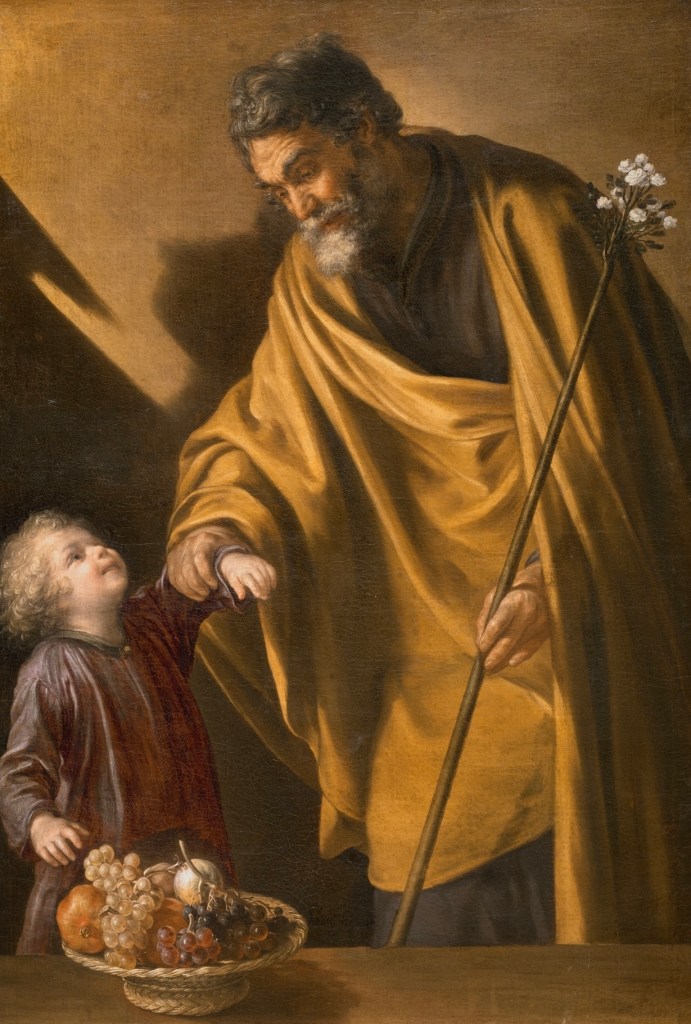
Sebastián Martínez Domedel (1615 – 1667), Saint Joseph with the Christ Child, c. 1650. Oil on canvas. The Prado, Madrid.

The Feast of Saint Joseph celebrated each year on the 19th March became common in Western Christianity as early as the 10th century and Saint Pope Pius V extended the observance to the entire Church in 1570. The day reminds catholics of Joseph as both a model of fatherhood and a protector of the Holy Family and the universal Church.

In this image, by the seventeenth century artist Sebastián Martínez Domedel, Joseph is portrayed as a concerned father, grasping Jesus’s arm to prevent him from taking fruit from the basket. While this might appear to be a common paternal rebuke, in this instance Joseph’s action is loaded with meaning, given the sacrificial and Eucharistic significance of both the Child’s violet tunic and the grapes and pomegranates that predominate in the fruit basket. For as Christ’s earthly guardian how strong must have been Joseph’s instinct to protect the infant from future suffering?

Sebastián Martínez Domedel is an artist that is undergoing a rediscovery. He was praised by the Spanish painter and author Antonio Palomino (1653-1726), who erroneously described him as a pupil of Diego Velázquez. Though comparatively little is known of Martínez’s life, he probably received his early artistic training in his hometown before completing his studies in Seville and Cordova. In 1660 he moved to Madrid, where he was named court painter to King Philip IV of Spain.

The Man of Sorrows

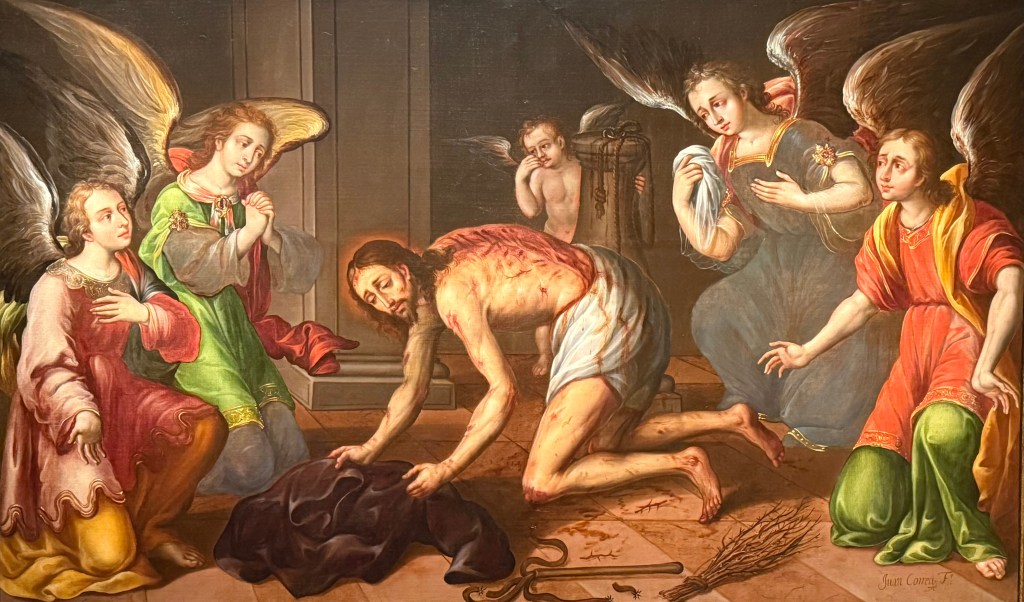
Juan Correa (c. 1645 – 1716), Christ Gathering His Garments after the Flagellation, c. 1670s. National Gallery of Art, Washington DC.

There are surely few more shocking artistic accounts of Christ’s flagellation than this image by the Mexican artist Juan Correa. Painted in the 1670s, Correa portrays Jesus on his hands and knees, pitifully reaching for his clothes after his bloody whipping at a column, the punishment handed down by Pontius Pilate as the usual prelude to crucifixion under Roman law. 

Yet, clearly this is no ordinary beating, the violence of the act being so terrible that the whip and the thorny twigs lie broken on the floor, with remnants of these instruments of torture appear embedded in Christ’s lacerated back. A scene so shocking that the five angels helplessly witnessing the event are reduced to copious tears.

Rodrigo of Córdoba

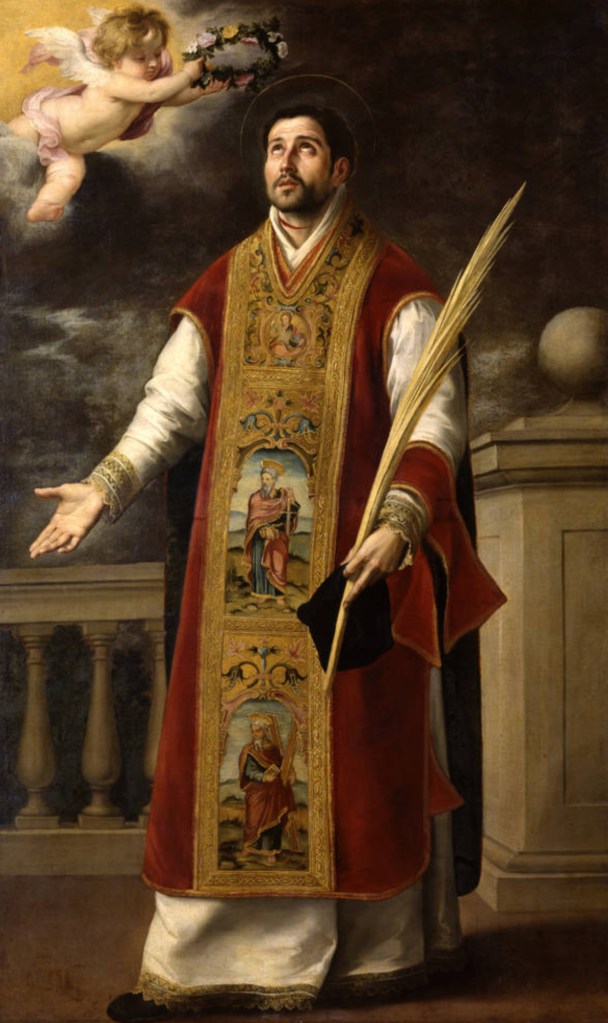
Bartolomé Esteban Murillo (1617-1682), Saint Rodrigo of Córdoba, c.1650-55.

he Roman Martyrology for 13th March recalls the death in the year 857 of Saint Rodrigo, a Christian priest of Mozarab background, venerated as one of the Martyrs of Córdoba.

Tradition states that Rodrigo had two brothers: one was a Muslim, the other irreligious. Once, after his brothers began to fight one another, he attempted to break them up, however, they turned on him instead and beat him.
When Rodrigo awoke, he found that his Muslim brother had reported to the authorities that the Rodrigo had converted to Islam. When our Saint maintained his loyalty to the Christian faith, he was accused of apostasy and then beheaded.

In this image of the Saint, painted around 1650 by Bartolomé Esteban Murillo (1617-1682), we do not see episodes from his life but rather the artist presents him in his vestments along with the symbols of his martyrdom: his neck reveals the wound that killed him. The palm frond held in his hand can be interpreted as a symbol of victory in the defence of his faith. The crown is being presented to the martyr is a heavenly reward for loyalty to God, while on his richly decorated vestments we see Saints Peter and Paul, who both lost their lives defending their faith.

The Joy of the World

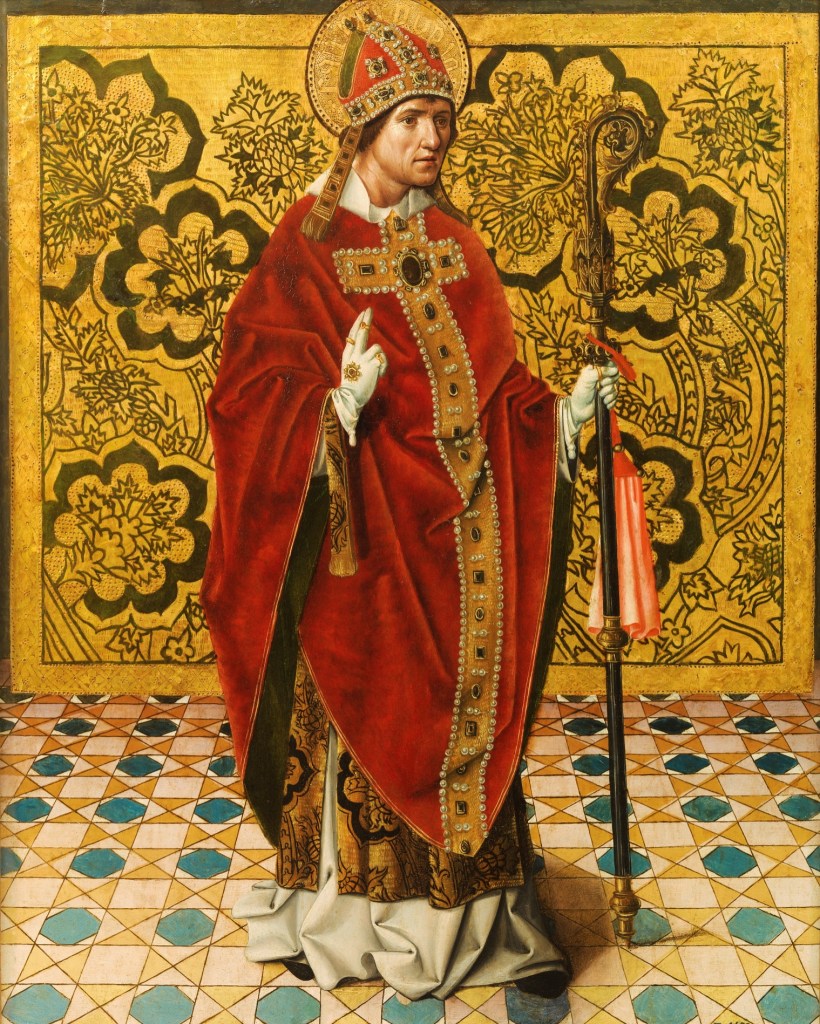
Juan de Nalda, Saint Gregory the Great, c.1500. The Prado.

For many Christians today is the feast of Saint Gregory the Great, Pope and Doctor of the Church who died on this day in the year 604.

As leader of the Church, Gregory kept a close watch over the clergy and encouraged them towards holiness. He used papal money to ransom prisoners and to care for persecuted Jews and victims of famine and sickness. People of his day called him the father of the city of Rome, and the joy of the world. However, Gregory is best known for his contributions to the liturgy. He reformed the Mass and the daily prayer of the Church and wrote prayers that are still in use today as well as commentaries on Scripture that shaped theology through the Middle Ages. He also collected melodies of plain chant used in the liturgy, known as Gregorian chant, after him.

This image of Gregory was painted around 1500 by the Riojan artist Juan de Nalda (active 1490-1510). Juan completed his artistic formation with Jean Changenet in Avignon. When he returned to Castile he worked mainly in Palencia and Burgos. The simplification of volumes in his work and the importance given to light show the influence of Provencal art. Notice also the striking contrast between the design of the pavement and the decorative gold sgraffito background.