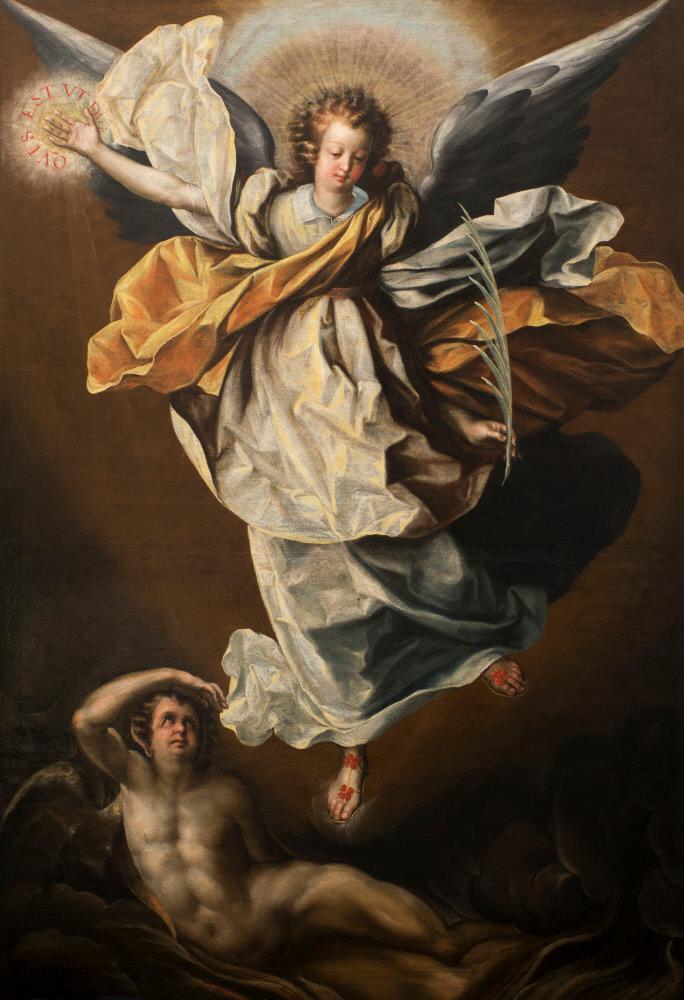
Quis est ut Deus

Luis Juárez (Mexico, ca. 1585/90–1639)
Saint Michael the Archangel Triumphant over Satan
Mexico, 1630s
Oil on canvas, 177 × 122 cm
The Hispanic Society of America, New York.

As some of us will already be struggling to maintain our Lenten commitments, feeling we have the devil on our shoulders, I thought this painting from the Mexican artist Luis Juárez might offer some encouragement.

In the picture, the Archangel Saint Michael hovers over a fallen demon with a satyr’s ears. This is Satan, whom Michael, in the biblical Book of Revelation (or Apocalypse, 12:7–9), casts to earth, where he will tempt humans. Michael’s right hand is surrounded with a sun disk bearing his motto, “Quis est ut Deus”—“who is like God”—the translation into Latin of the Hebrew name “MijaEl.”

Luis Juárez is documented as working in Mexico City from 1609 to 1639, and presumably was born around 1585–1590. Works by Luis Juárez exhibit the influence of Spanish painters active in Mexico, such as Alonso Vázquez, with whom he may have trained. This image is also derived in part from two compositions by the Netherlandish artist Maerten de Vos (1532–1603) and engraved by Hieronymus Wierix (1548–1624), though neither prints were slavishly copied. The works of Juárez and his contemporaries set the stage for the arrival in Mexico in the 1630s of the 17th-century tenebrist style, with its sharper contrasts of light and dark and dynamic compositions.
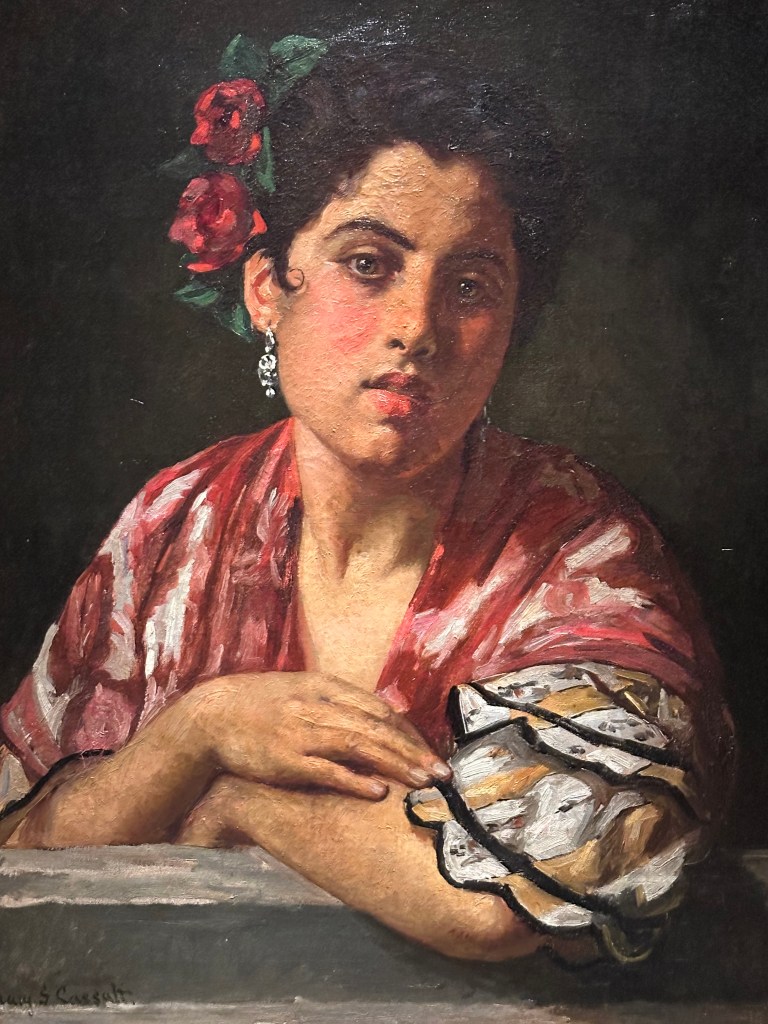
The lady of the Casa Pilatos

Mary Cassatt (1844-1926), Muchacha española apoyada en un alfeizar, 1872. Manuel Piñanes García-Olías.

To celebrate International Women’s Day I’m sharing Mary Cassatt’s ‘Spanish Girl leaning on a Window Sill’.

Between 1872 and 1873, the American artist Mary Cassatt spent six months in Seville at the palace of the Duke and Duchess of Medinaceli, who often hosted friends, foreign travellers and painters. Cassatt, who worked hard and rarely left her studio, became known in the city as the lady of the Casa Pilatos.

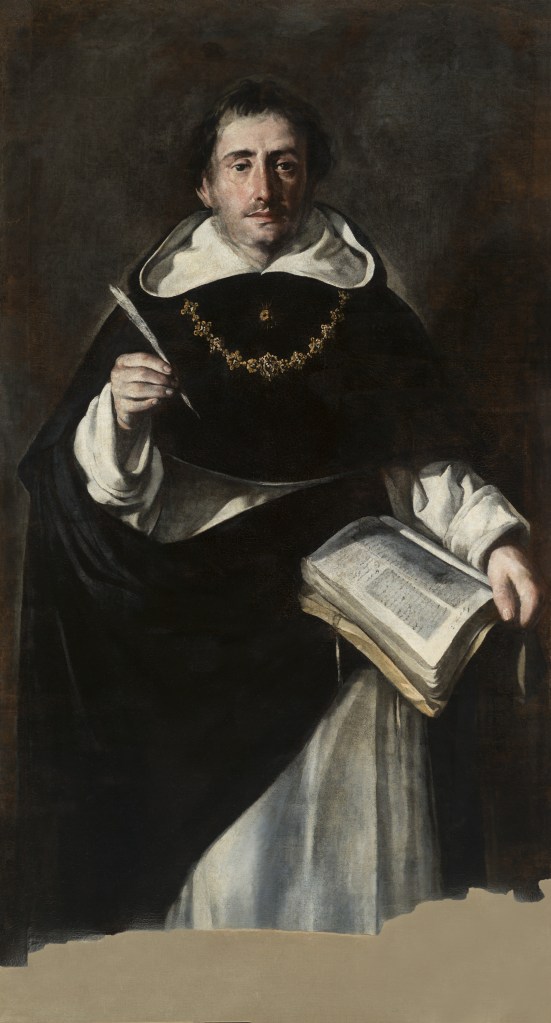
The Angelic Doctor

Antonio del Castillo y Saavedra, Saint Thomas Aquinas, c.1649. Museo de Bellas Artes de Córdoba.

Today is the Feast of Saint Thomas Aquinas (c. 1225 – 7 March 1274) the Dominican friar and priest, and one of the most influential philosophers and theologians in the Western tradition.

Thomas was born in Roccasecca, near Aquino, controlled then by the Kingdom of Sicily, and in this portrayal of the saint by Antonio del Castillo y Saavedra (1616 – 1668) Thomas stands with his pen raised as if he is ready to write, perhaps his famous ‘Summa’ – judging by the size of the large book at his side. As if to emphasise Dominican balance between study and contemplation Thomas appears to have paused his intellectual activity as if he is waiting to receive divine illumination. 

Castillo introduces all the attributes necessary to identify the saint, in particular the black and white habit of the Dominicans, the gold chain related to his “Catena aurea” and the small sun on his chest, a pictogram of Pius V’s declaration referring to the saint as “the brightest light of the Church”.

Castillo’s Thomas is given a highly individual appearance, with a long nose and full lips framed by a small moustache, suggesting the artist used a life model. Possibly, the model was chosen for his strong build and short neck, which is in keeping with Saint Thomas’s nickname, the Sicilian ox, acquired during his student days in Cologne. 

This work would originally have been the same size as a companion piece of Saint Bonaventure, but it was probably cut down to eliminate damage caused by the damp in the convent where it spent much of its life, and Saint Thomas lost his legs below the knee.

The Temptation of Christ

Juan de Flandes, The Temptation of Christ, c.1500/1504. Oil on panel. The National Gallery of Art, Washington DC.

For Catholics throughout the world today marks the beginning of the season of Lent, a 40 day period of penance and abstinence in preparation for the celebration of Holy Week and Easter. The 40 days is a reminder of the period that Jesus spent in the wilderness being tempted by the Devil at the beginning of his ministry.

In this rare portrayal of the temptations of Christ, made by Juan de Flandes for Queen Isabel of Castile, we see the devil portrayed as monk with a long, pointed beard and two sharp, bone-white horns curving back from the top of his head and a claw-like, webbed foot protruding from under the hem of his long robe. He has a prominent, hooked nose, sunken eyes, and appears to be clutching in one the rosary beads hanging from his waist, while in the other he holds a round, loaf-sized stone in an effort to tempt Jesus to break his fast.

A steep, rocky cliff rises at the left of panel, where two strokes of light blue and pale beige suggest two people standing atop the cliff, as the Devil offers Jesus earthly power. Beyond, a city with tan-colored stone buildings and blue mountains are hazy in the distance. Atop a tower in the city, the pair of men appear again, with the Devil gesturing down at the Temple as he urges Jesus to show his power by destroying and rebuilding the holy place.

Wishing everyone a peaceful and fruitful Lent!

A surrealist carnival

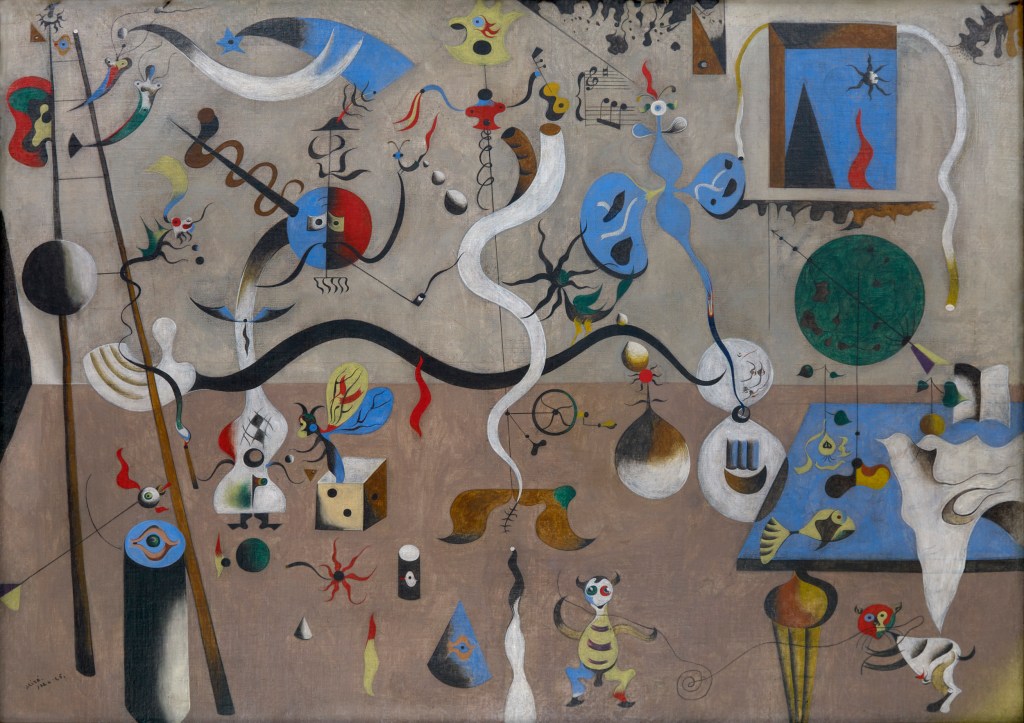
Joan Miró, The Harlequin’s Carnival, 1925, Albright-Knox Art Gallery, Buffalo, NY.

With the Carnival season about to reach its climax, here is The Harlequin’s Carnival by Catalan artist Joan Miró (1893-1983).

In 1924, poet André Breton formed the Surrealist movement, around the time Miró started to focus on dreams and the subconscious as artistic material, fused with his own life experiences and memories.

Created between 1924 and 1925, Miró’s harlequin resembles a guitar, yet he still retains some of his harlequin characteristics such as a checkered costume, a mustache, an admiral’s hat, and a pipe. However, the harlequin in this painting is sad, which could be due to the hole in his stomach, a detail that may refer to Miró’s personal life experiences as he had little money for food and was on the brink of starvation. 

Overall this is a painting of a celebration; all the characters seem to be happy due to the fact they are playing, singing, and dancing. Some of the objects in the painting are anthropomorphized, for example the ladder to the left of the painting, which has an ear and an eye. According to Miró, the ladder is a symbol of flight, evasion, and elevation. The cat in the bottom right of the painting represents Miró’s actual cat, who was always next to him as he painted. 

The painting includes many other fantastical and magical elements such as mermaids, fish out of water, dancing cats, shooting stars, a creature with wings in a box resembling a dice, floating musical notes, and a floating hand, all contributing to a magical atmosphere within this composition.

Hand in Hand. Sculpture and colour in the Spanish Golden Age

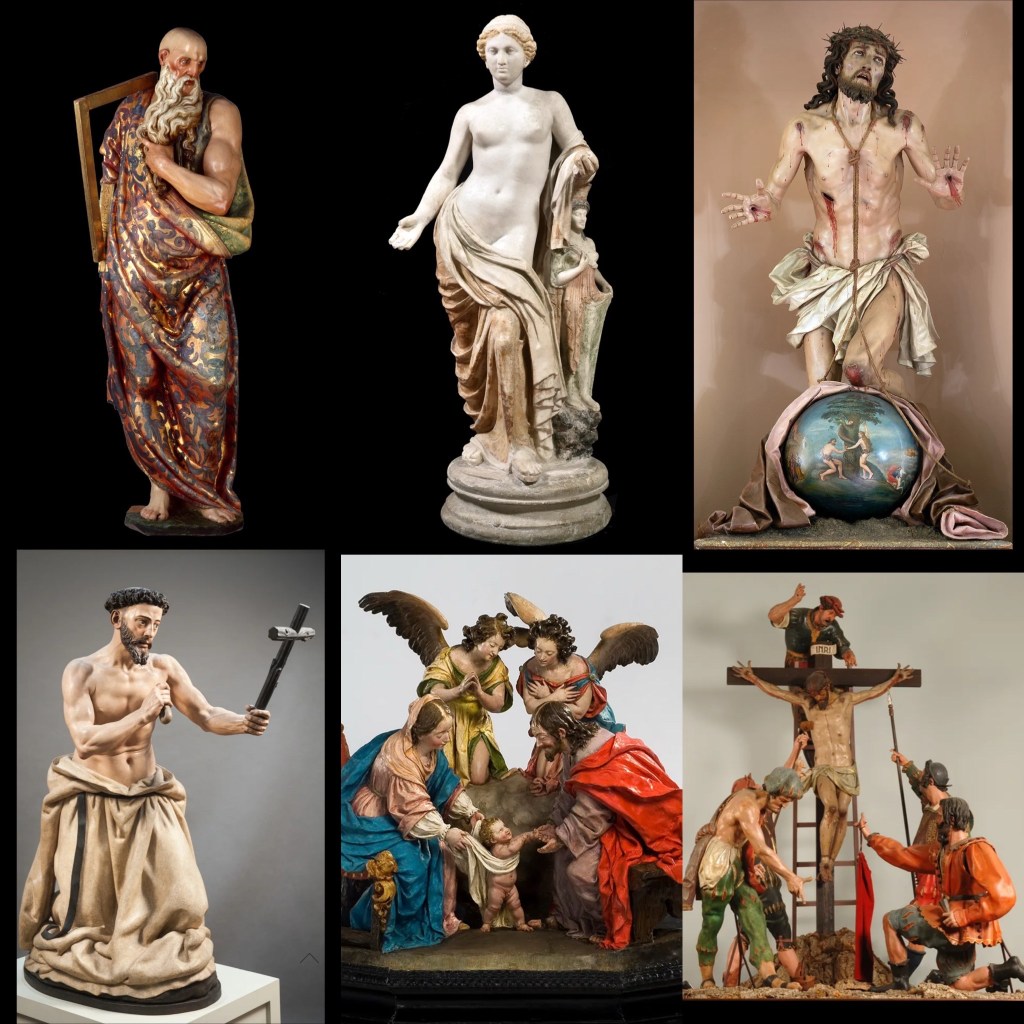
Following on from the Valladolid shows devoted to the great Spanish masters of polychrome art, this week of posts ends in Madrid with the Prado’s current exhibition that explores the whole relationship between sculptures and painters. The show is titled ‘Hand in Hand. Sculpture and colour in the Spanish Golden Age’ – a reference to the theorist Antonio Palomino (1655–1726) who in praising the sculpture of Christ of Forgiveness, carved by Manuel Pereira and polychromed by Francisco Camilo, ended with the following phrase: “And so painting and sculpture, taking each other by the hand, are a wondrous sight”. 

The exhibition explores the synthesis of volume and colour, a phenomenon that reached new heights in the context of the Iberian early modern world. Charting the unbroken continuity with classical tradition, the curators make a convincing case for the special role of painted sculpture as a tool of persuasion.

The struggles of a woman sculptor

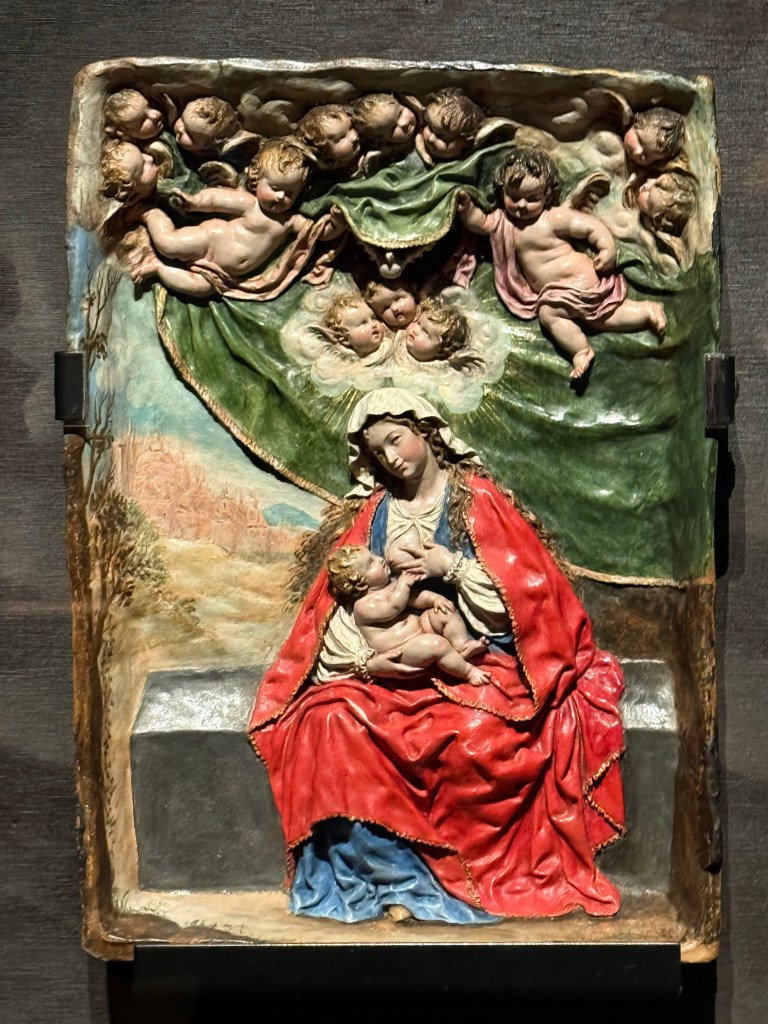
Luisa Roldán and Tomás de los Arcos, Virgin and Child, c.1689-1706. Polychromed clay. Museo de Bellas Artes de Sevilla.

Luisa Roldán was born in Seville, the daughter of sculptor Pedro Roldán and his wife Teresa de Ortega. She was taught by her father, alongside her siblings, how to draw, utilize clay to shape figures and finally sculpt or carve in wood. She became an apprentice in her father’s workshop. Also working within the workshop was Luis Antonio de los Arcos, who Roldán married when she was 19, against the wishes of her family.

From 1686 to 1688 Roldán worked in Cadiz establishing her own workshop, together with her husband and her brother-in-law, Tomás de los Arcos, to create religious polychromed wooden sculptures. Roldán was the principal sculptor, while her husband and her brother-in-law worked as the ‘encarnado’, a specialist in painting flesh tones.

Although Roldán became the Escultor de Cámara, or Court Sculptor, to the Habsburg King Charles II, she struggled financially. Roldán gave birth to seven children, only two of whom survived to adulthood. Of the five who died, the cause of death in two cases was malnutrition. Roldán eventually died in poverty in Madrid in 1706, even though on the day of her death, she was given the title of “Academician Merit” from the Accademia di San Luca in Rome.

La Roldana

To celebrate ‘La Día de Andalucia’ I am highlighting works by Luisa Roldán (1652 – 1706). Known also as La Roldana, Luisa is the earliest woman sculptor documented in Spain and recognised for being one of the few women artists to have maintained a studio outside the convents in Golden Age Spain.

These works, all currently in a remarkable show at @museo.escultura in Valladolid, demonstrate the breadth of her skill and achievements. Spanning her first works in the studio of her father, Pedro Roldán, to the small terracotta pieces produced for refined Baroque tastes of the Court in Madrid.

Although Roldán became the Escultor de Cámara, or Court Sculptor, to the Habsburg King Charles II, she struggled financially. Like many artists of her time she died poor, signing a declaration of poverty shortly before her death. On the day of her death, Roldan was given the title of “Academician Merit” from the Accademia di San Luca in Rome.

Luisa influenced several women artists in Seville, Cadiz and Madrid through her sculptures and artistic innovation. Women artists at the time were seen as belonging to a “private” sphere and men to a “public” sphere. When Roldan created her sculptures she made her work public and changed the way art was perceived in the 1600s.

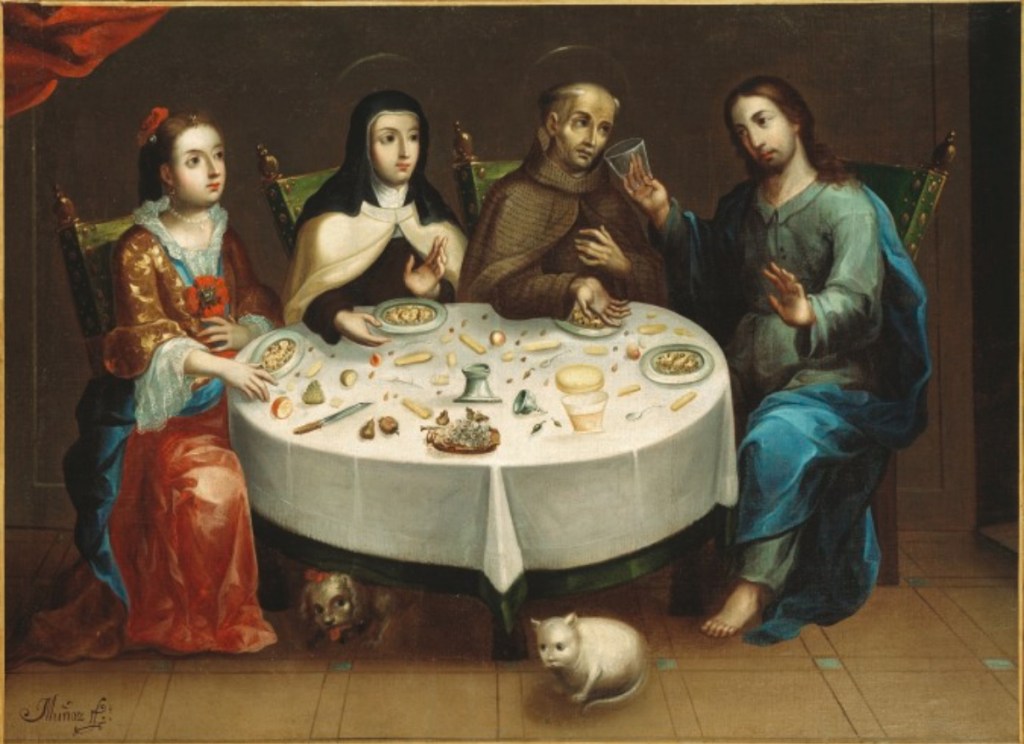
Supper with the Saints

Gaspar Muñoz de Salazar, active in Puebla, Mexico circa 1700-1750,
Mystic Dinner (Doña Guiomar of Ulloa, Saint Teresa of Avila, Saint Peter of Alcantara, Christ), c.1730,
Oil on canvas, 73x39cm, Denver Art Museum.

Have you ever thought what it might be like to meet a living saint and perhaps share a meal and a conversation? This was the experience of Doña Guiomar (far left), a wealthy widow who lived in Avila in the mid 16th century. She welcomed into her house leading religious figures of the time and was a patron of the Discalced Franciscans, with whom St. Peter of Alcántara (second from right) was affiliated, and of the Reformed Carmelite Order founded by St. Teresa of Ávila (second from left). According to legend Doña Guiomar introduced Peter and Teresa in 1558. Followers of both Peter and Teresa wrote of occasions in which they witnessed Peter being given food and drink by Christ (far right), who also attends this banquet painted around 1730 in Mexico by Gaspar Muñoz de Salazar.

While clearly religious painting, Muñoz sets the scene in an entirely domestic setting that includes a delightful portrayal of pets, a subject that is uncommon in Mexican colonial art. The four figures sit in 18th-century green covered chairs around a table, with a silver saltcellar at its the centre and with food and silverware strewn about. The fruits on the table appear to represent a mixture of those introduced to the Americas from Europe (grapes, pear, pomegranate) and ones native to the Americas (chirimoya, guanabana, chilis).

Imágenes Vestideras

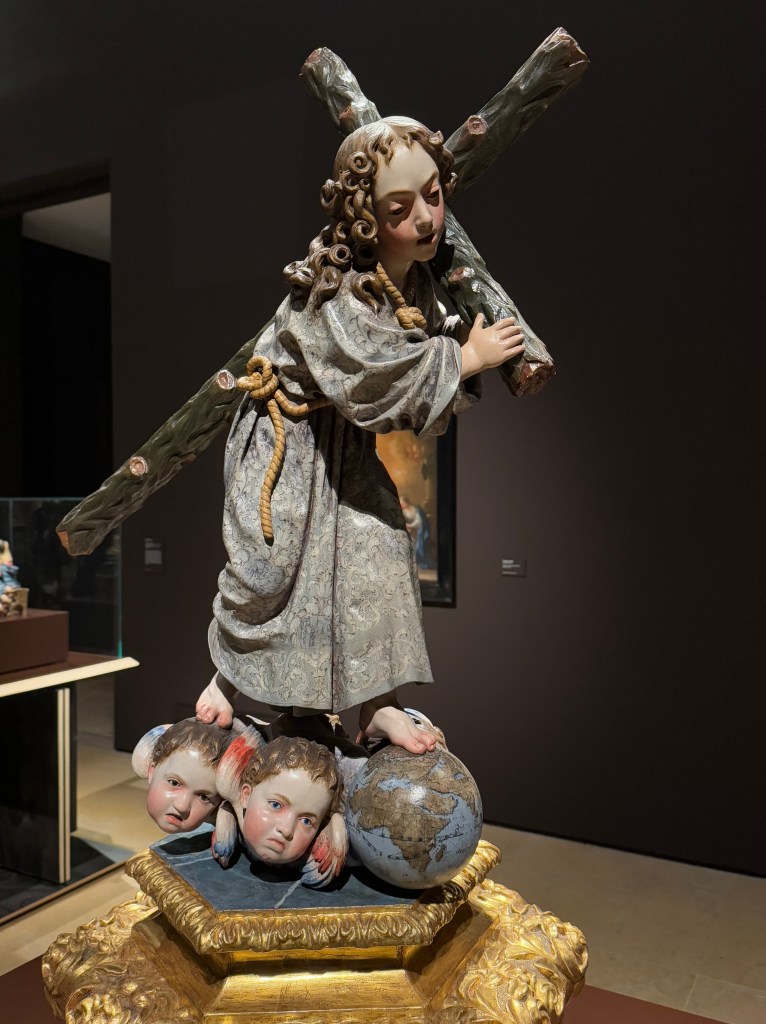
Juan de Mesa and Juan Martínez Montañés, Imágenes Vestideras of Saints Paul Miki, John Soan de Goto and James Kisai, late 1620s. Museo de Bellas Artes de Sevilla.

On 5 Feburary 1597, a group of twenty-six Christians were executed by crucifixion in Nagasaki, Japan. Twenty of them were Japanese, both monks and laymen. Most of the monks were Franciscans, but not all of them. They included the three Jesuits, born in Japan and converts to Catholicism, presented here: the monks Paul Miki (Kyoto, 1556 or 1562) and John Soan de Goto (Goto, 1578), and the lay brother James Kisai (Haga, Okayama, 1533). Thirty years later, in 1627, they were beatified by Pope Urban VIII and in 1862 they were finally canonised.

These sculptures, by Juan de Mesa and Juan Martínez Montañés, come from the professed house of the Society of Jesus in Seville. Although they bear no date, they were likely commissioned when the martyrs were beatified in 1627, an event that led to their public veneration.

Although none of these works has preserved its iconographic attributes, the Martyrs of Japan are usually depicted with crosses, in memory of their crucifixion, and the spears that killed them. Now restored to their original state, they are displayed as prime examples of the ‘imágenes vestideras’, or statues designed to be dressed, characteristic of so many Sevillian polychromed sculptures.