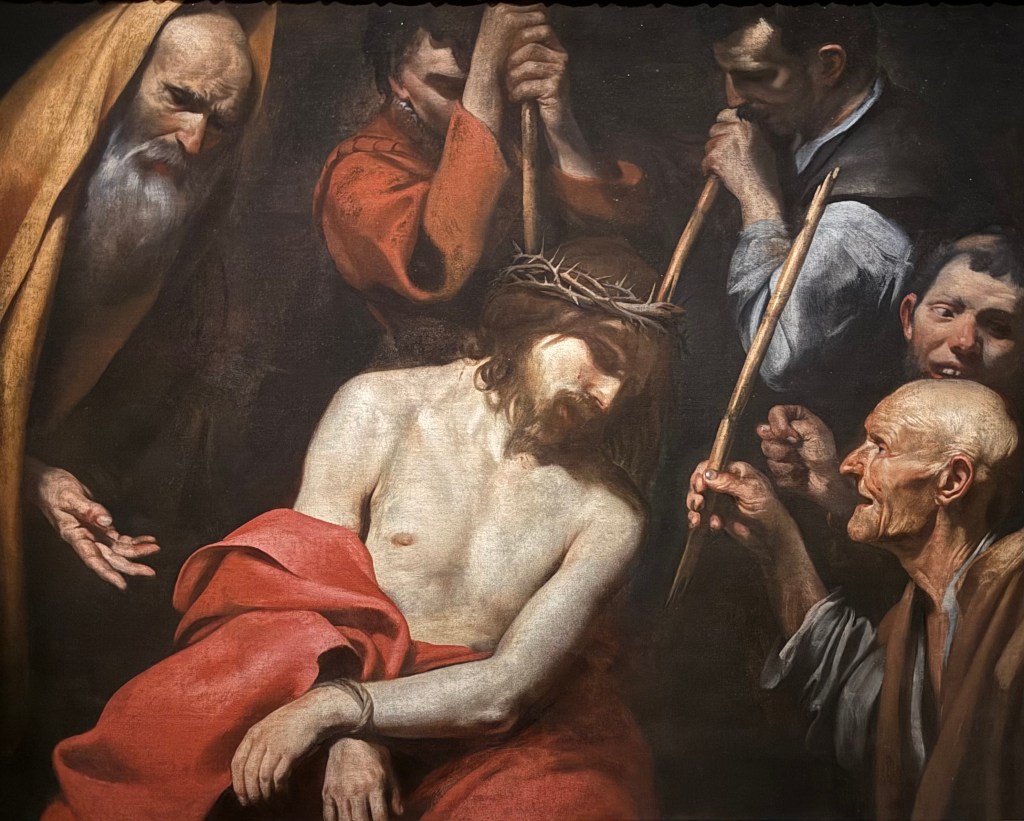
JUSEPE DE RIBERA, The Crowning with Thorns, c.1611-1612, Rob Smeets Gallery, Geneva.
Many scenes showing the crowning of thorns were inspired by a famous version by Caravaggio. Yet in this tragic scene the youthful Ribera appropriated this prototype and reinvented it. Among the executioners, we find the famous bald model once again, as well as a grimacing young man, who with his thumb placed between his index and middle fingers, makes an insulting gesture known as the “fica”. This gesture, imbued with an obvious sexual connotation, comes from the underworld of Baroque Rome, with which Ribera was undoubtedly familiar.
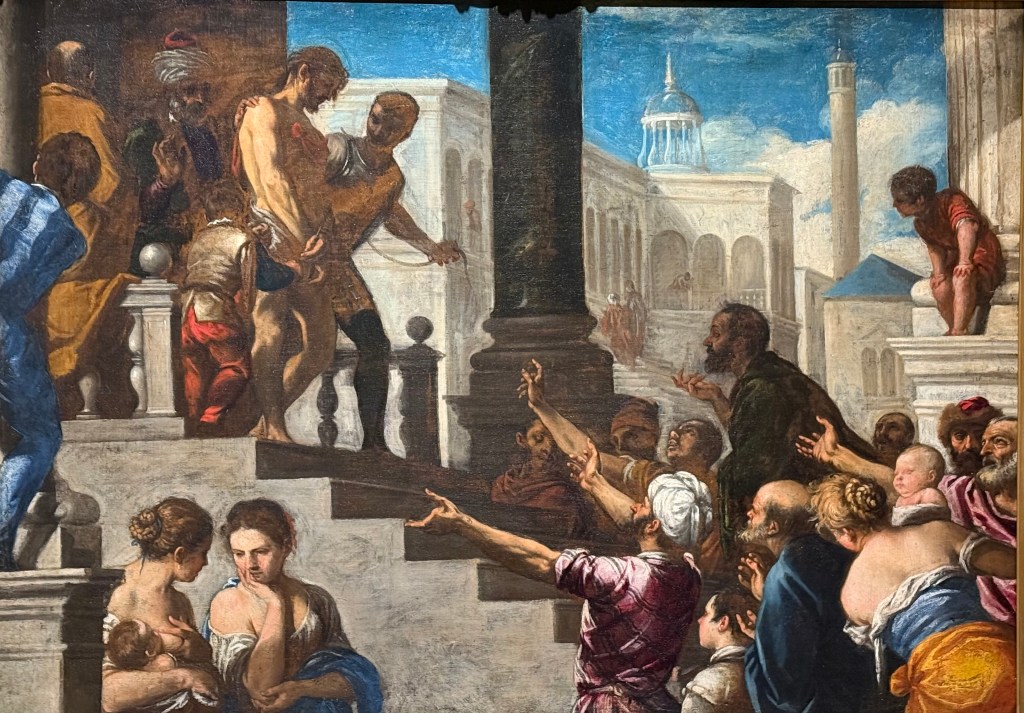
Pedro Orrente (1580-1645), Еcce Homo, са. 1610. Walters Art Museum, Baltimore.
Christ stands at the top of the stairs and is mocked by a Roman soldier, while the Roman governor Pontius Pilate gestures to the crowd, declaring, “Look, I am bringing him out to you to let you know that I find no case against him” (John 19:4).
The Spanish painter Orrente’s use of dark silhouettes for figures and architecture set into a narrow plane next to the surface of the painting heightens the emotional intensity of the event and reflects the influence of works by 16th-century Venetian painters, such as the Bassano family, Tintoretto, and Veronese. The architecture also recalls that of Venice. Orrente’s trip to Venice must have taken place shortly before 1611, by which time the painter was back in Spain.
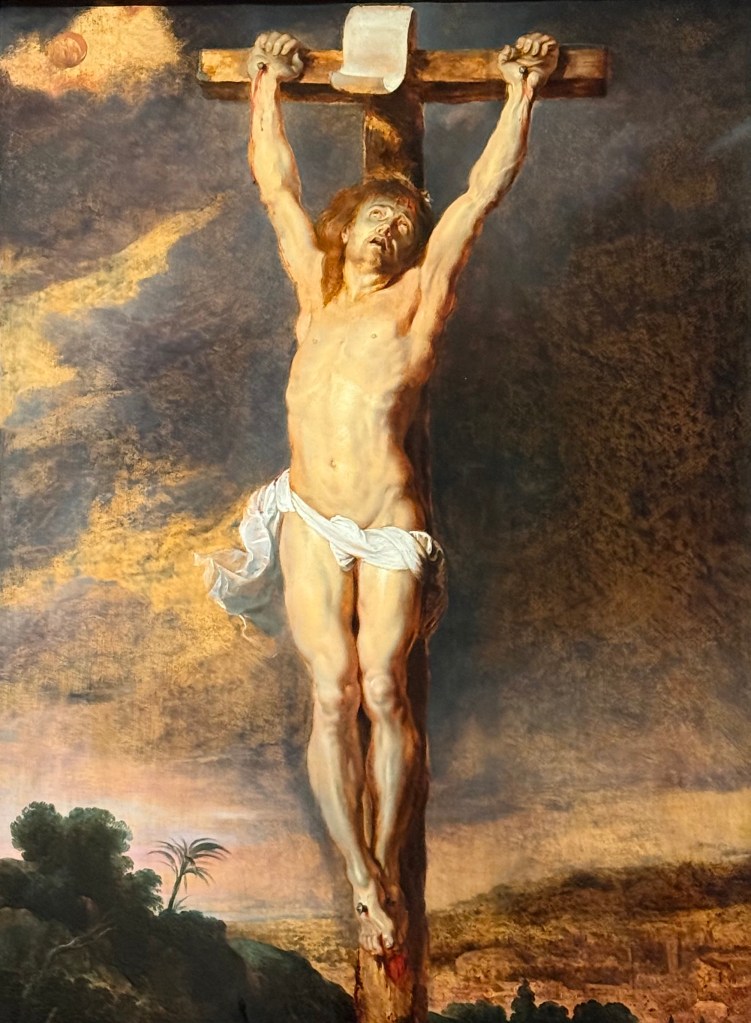
Peter Paul Rubens (1577-1640), The Crucifixion, about 1610-12. Museum of Fine Arts Boston.
Conventional representations of the Crucifixion highlight Jesus’s suffering by showing an emaciated figure hanging limply with downcast eyes. However, in this image by the Flemish artist Peter Paul Rubens we see a radical departure from this tradition. Rather than a tortured martyr, this Christ is heroically alive. He raised his eyes trustingly toward the heavens. His muscular body, derived from ancient Roman sculpture, is brilliantly lit. Thus, the artist emphasises Jesus’s divinity, showing the faithful that his sacrifice will ensure their salvation.
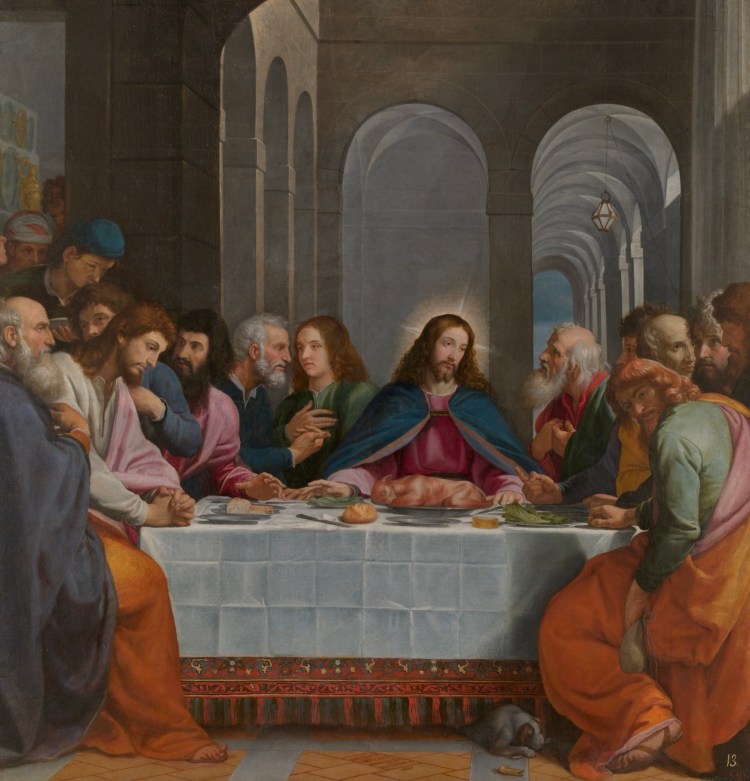
Carducho, Bartolomé (1560 – 1608), The Last Supper, 1605. The Prado, Madrid.
The Florentine Bartolomé Carducho was one of the founders of the Madrid school of painting. His work deploys a masterly use of drawing, an ordered sense of composition and a warm palette toned by a carefully controlled light. Rather than the more traditional image of the consecration of the Eucharist, in this Last Supper Carducho focuses on the Apostles’ varied reactions to Christ’s announcement that one will betray him.
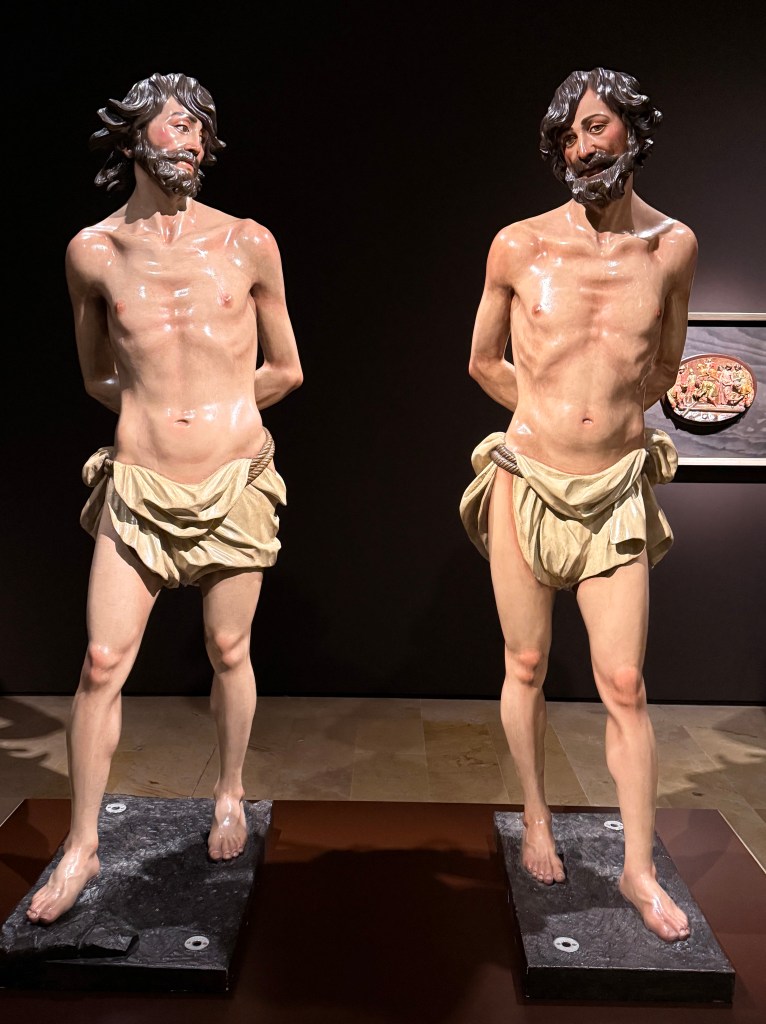
Luisa Roldán (1652-1706) y Luis Antonio de los Arcos (1652-1711), San Dimas y Gestas. Paso de la Exaltación, c. 1678-1682. Hermandad Sacramental de la Exaltación, Sevilla.
In the older rites of the Church on the Wednesday of Holy Week it is the tradition to read the Passion from the Gospel of Saint Luke. One of the most beautiful passages from this account are the words that passed between Jesus and Saint Dismas, the penitent thief who was crucified with him: ‘and he said to Jesus: Lord, remember me when thou shalt come into thy kingdom. And Jesus said to him: Amen I say to thee, this day thou shalt be with me in paradise.’
These two polychrome processional sculptures of Dismas and the unrepentant thief Gestas were made by Luisa Roldán and Luis Antonio de los Arcos (1652-1711). Although contracted to her husband because of the legal limitations on women, much of the work was undertaken by Luisa. Processional sculpture was a complex genre due to their sizes and the way in which these scenes were viewed by devotees. The two thieves, with their rangy anatomies and pronounced bones, naked except for a scanty cloth, are all the more remarkable as they show the outstanding knowledge of anatomy achieved by Luisa despite the impediments imposed on women by the artist’s guild and the Sevillian Academy.
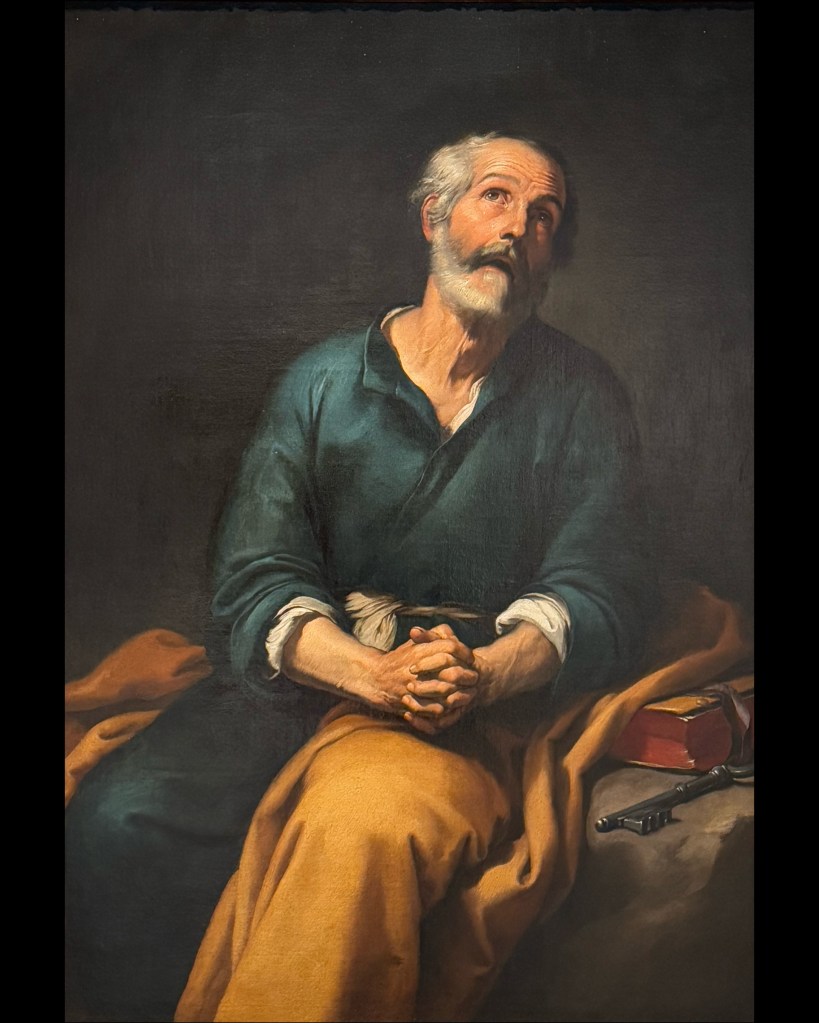
Bartolomé Esteban Murillo (1617 – 1682), Saint Peter in Tears c. 1650-1655. Museo de Bellas Artes de Bilbao.
On the Tuesday of Holy Week the readings at today’s Mass focus on the Jesus predicting the betrayal of Judas and the denial of Saint Peter.
The iconography of the image expresses the idea of the value of repentance personified in the example of Saint Peter who, at a crucial moment of the Passion, denies Christ three times before hearing the rooster crow, just as the Lord had said. The tears on his face convey a deep expression of grief and supplication for forgiveness.
Murillo painted variations on this theme throughout his life, of which this is the earliest known version. The long, impasto brushwork was a hallmark of his technique in the early 1650s, when he was influenced by Jusepe de Ribera.
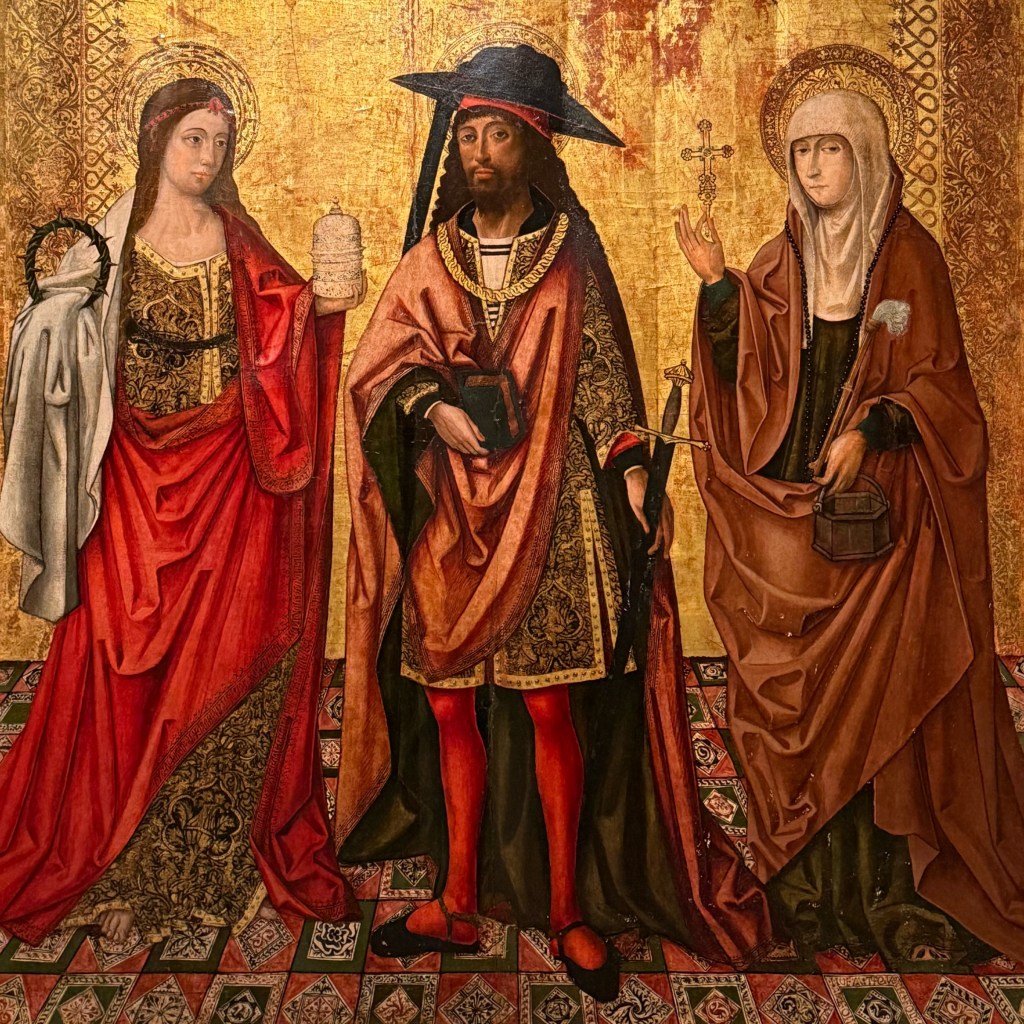
Maestro de Peres, Saint Lazarus with his Sisters Martha and Mary, Valencian School, early i6th century. Museo Lázaro Galdiano, Madrid.
On the Monday of Holy Week the Gospel at today’s Mass recalls that six days before the Passover Jesus ‘came to Bethania, where Lazarus had been dead, whom Jesus raised to life. And they made him a supper there: and Martha served: but Lazarus was one of them that were at table with him. Mary therefore took a pound of ointment of right spikenard, of great price, and anointed the feet of Jesus, and wiped his feet with her hair; and the house was filled with the odour of the ointment.’
The amazement of a man brought back from death and a house filled with the scent of expensive perfume, must have stunned the onlookers, all but Judas who complained of the price of the ointment. In this panel from early sixteenth century Valencia, our eyes are certainly dazzled by the gold ground and the richness of the fine clothes in which they are dressed, and the donor of this panel clearly did not count the cost when commissioning such an opulent image of these three close friends of Jesus.
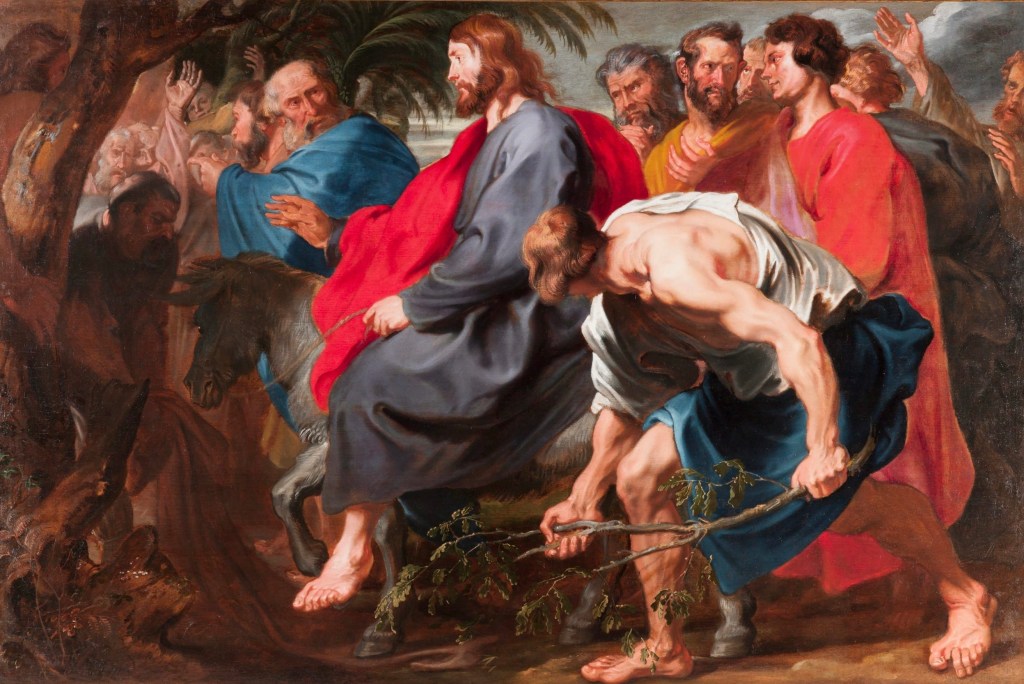
Anthony van Dyck (1599–1641), The Entry of Christ into Jerusalem, c. 1617. The Indianapolis Museum of Art.
Many Christians around the world today will be celebrating Palm Sunday, Christ’s final entry into Jerusalem and the beginning of that last journey to his death and resurrection. A week that sees Jesus welcomed as an earthly King with shouts of Hosanna before his murder with common criminals, a testament to the worst traits of the human condition, one that Antony van Dyck captures brilliantly in the crowded Palm Sunday image, dominated as it is by an overwhelming and brutal masculinity.
In 1618, Peter Paul Rubens referred to the young Anthony van Dyck as “the best of my pupils.” This painting, which may have been created as early as 1617, when the artist was only 18 years old, provides a clear demonstration of Van Dyck’s remarkably precocious talent. He was already a master of Rubens’s epic baroque style, seen in the muscular figure who stoops to cast a branch in Christ’s path. The coarse realism of this figure and his companions, together with the crowded restlessness of the composition, are hallmarks of Van Dyck’s youthful style.
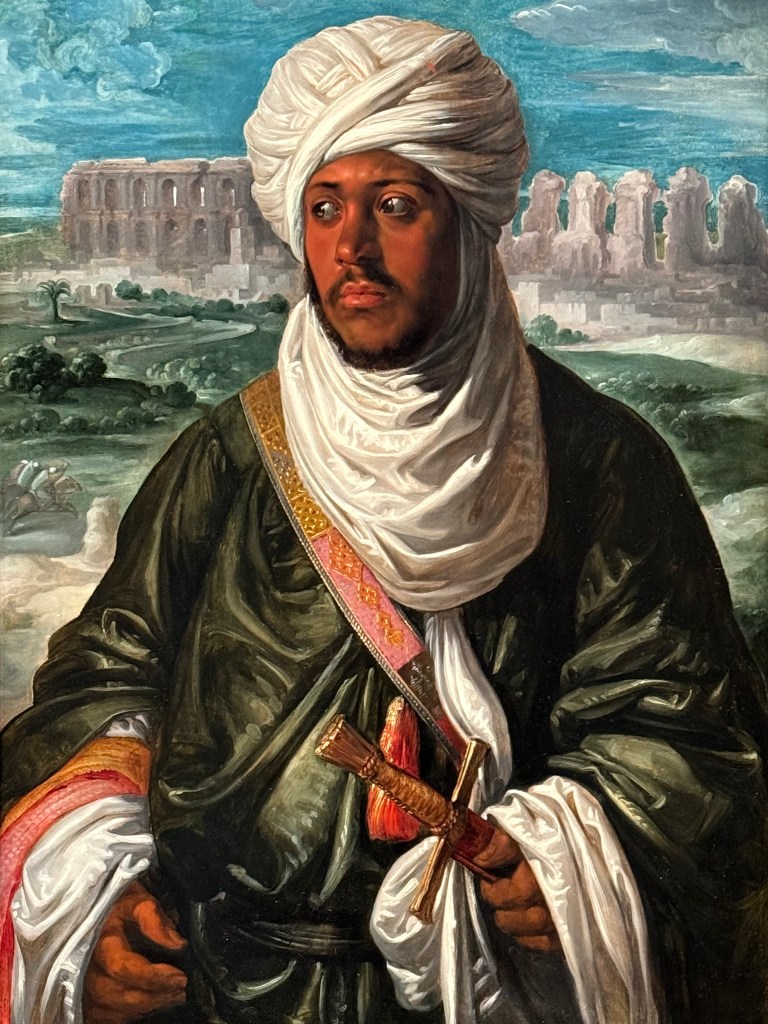
Peter Paul Rubens (1577-1640), Mulay Ahmad, c.1609. Museum of Fine Arts, Boston.
This portrait of Mulay Ahmad, the ruler of Tunis, is a rare 17th-century portrayal of an African sovereign. But it’s not a portrait from life. Rubens based the painting on an earlier work by Jan Vermeyen, who traveled to North Africa in 1535 on a military campaign led by the Holy Roman Emperor.
Rubens clearly valued this painting, for he kept it his entire life. He used it repeatedly as the model for the African king in paintings of the three kings who travel to Bethlehem to adore the infant Jesus. Rubens’s insistence on an authentic depiction of an African monarch is in keeping with the period’s impulse to discover, describe, and represent the wider world.
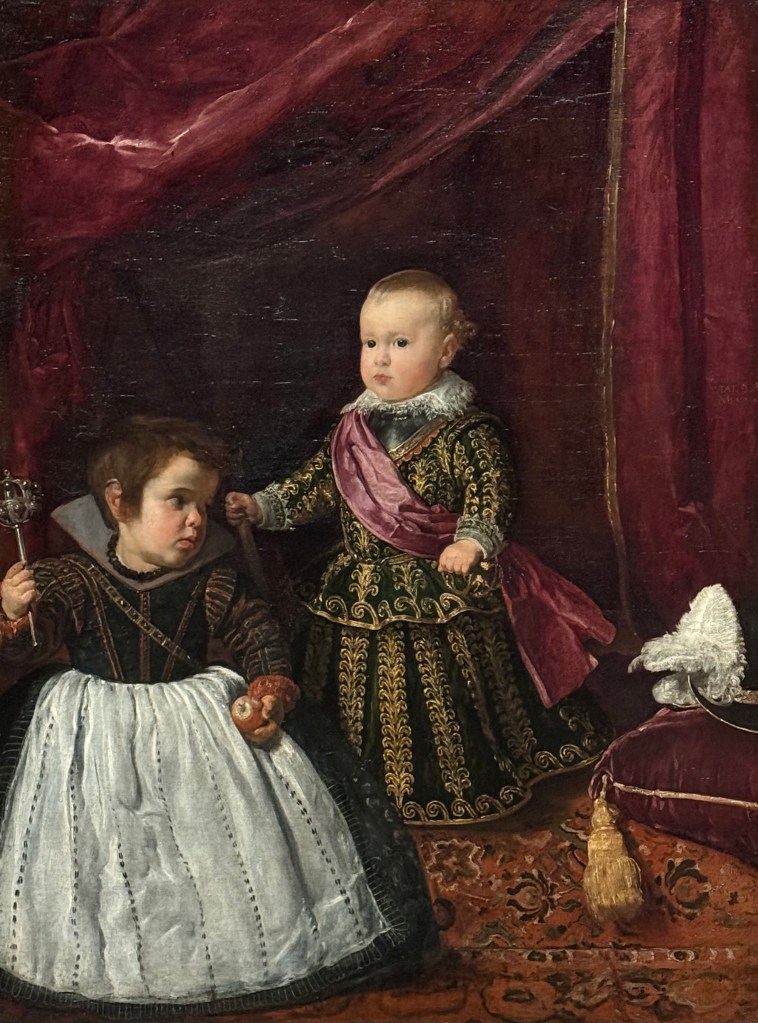
Diego Rodriguez de Silva y Velázquez (1599-1660), Don Baltasar Carlos and an Attendant, 1632. Museum of Fine Arts Boston.
Baltasar Carlos, two-year-old heir to the Spanish throne, was the son of Philip IV. As official painter to the king, Velázquez created countless portraits of Philip and his family. Here, despite his young age, the prince is posed as an adult, standing at attention next to a person with dwarfism, who may be a jester. Baltasar grips the baton of power and the hilt of his small sword. The attendant holds a rattle and apple, which are a toy and a snack for the prince. Their shapes allude to the scepter and orb, symbols of regal authority.
 The Arts of Golden Age Spain and the Hispanic World