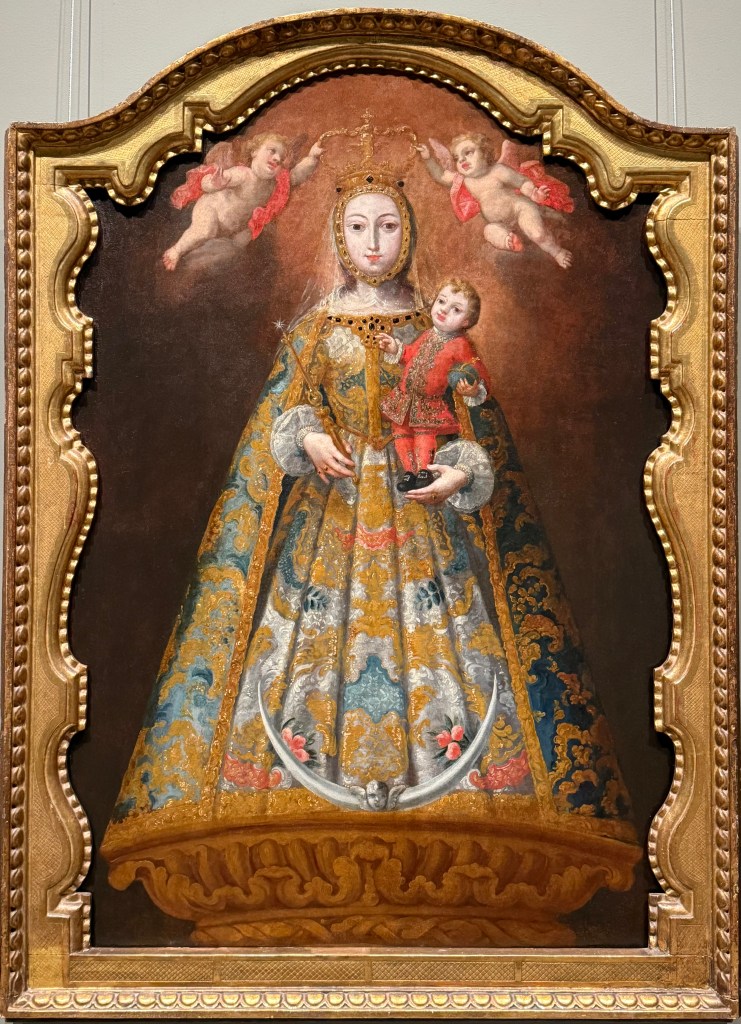
Juan Pedro López (1724-1787), Nuestra Señora de Guía (Our Lady of Guidance), c.1762. Oil on panel. Museum of Fine Arts Boston.
Beginning around 1668, Spanish colonizers in Venezuela wrote stories about a sculpture of the Virgin Mary found floating in the ocean. Some said that she protected sailors from pirates, others described how she led a lost ship safely to shore. Venerated for miraculous acts of guidance, the sculpture was placed in a church in Caracas, dressed in richly embroidered clothing, and adorned with jewels. Just as faithful people cared for the sculpture like a living being, artists painted her portrait. Here, the Venezuelan artist Juan Pedro López depicts the Virgin with life-like details— her fingers gently curl around a scepter and the Christ child, and her eyes seem to gaze directly into ours.
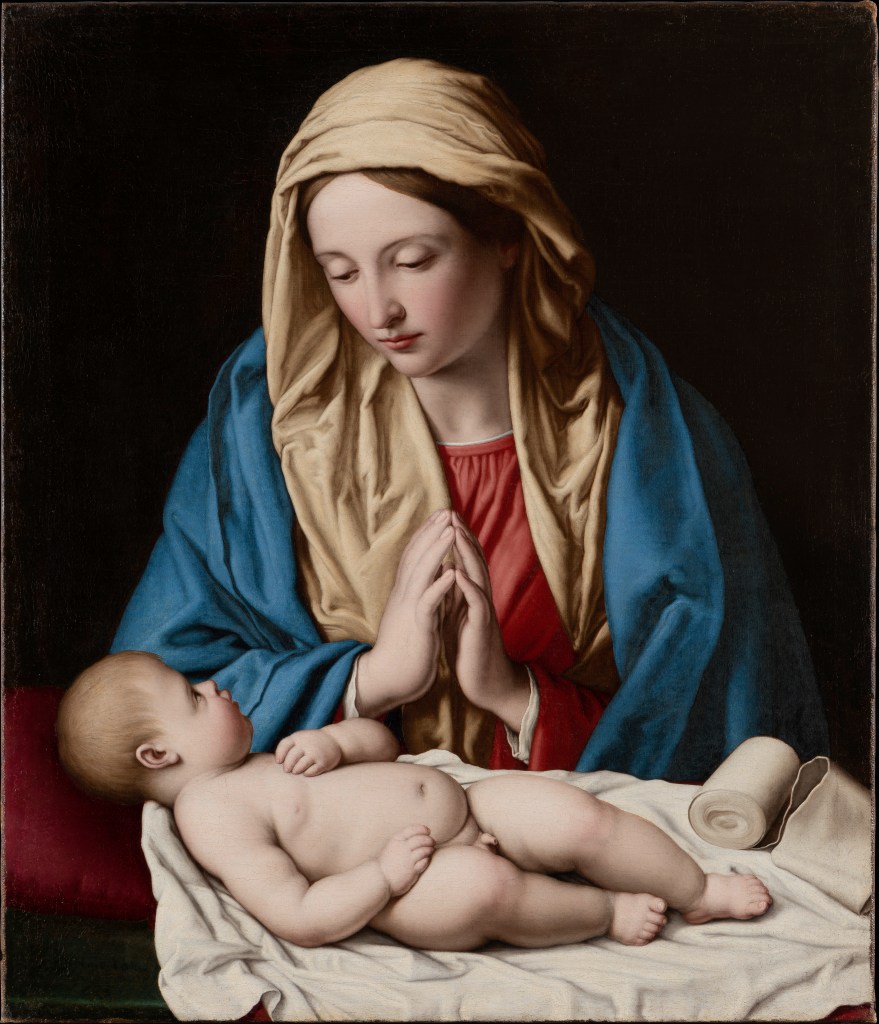
Sassoferrato, Mary worshipping the Christ Child, c.1640-60, Städel Museum, Frankfurt am Main.
Artists and philosophers have long struggled with questions of what art is for and how it shapes our experience as viewers. When it comes to sacred art the answers to these questions may seem more obvious, for here an artwork is usually required to illuminate some aspect of our faith and spark in us a devotional and prayerful response. Many will recognise the feelings of sorrow, grief and possibly even guilt when we look upon an image of Jesus suffering on the cross. Likewise, when confronted with paintings of Christian martyrs we may experience in our own bodies a sense of their pain and anguish, in a similar manner to the empathy we feel for the pain of others in our daily lives as we visit family who are sick or watch the never-ending human tragedies that dominate the nightly television news. Yet, for all that art can hold a mirror to the more painful aspects of our lives, the more challenging emotions to depict in paint or stone are surely the brighter but less tangible feelings of joy, love and most especially hope.
As an art historian my working days are spent trying to understand how works of art were created and how they speak to those, both past and present, who encounter them. However, even with a trained eye I cannot hide the difficulty in seeing hope, an emotion that is both intensely internal and individual. Our personal hopes and dreams are as unique as the pattern of our eyes or the lines on the palms of our hands. Hope also inevitably points toward a future state of being that is distinctly better than our current life. To portray this ineffable emotion, artists must therefore deploy the cleverest of techniques and pictorial strategies to reveal something so hidden in the human heart, producing artworks that are capable of engaging the viewer in both our present reality and our desires for what it yet to come. Here the makers of Christian art may have an advantage over their purely secular counterparts, for the Church has long held that the highest purpose of religious art is to use the artist’s God given talents to direct the beholder towards events and beliefs whose meanings lie quite rightly beyond our material world. As the writer of Ecclesiastes so eloquently explains, ‘He has made everything beautiful in its time. Also, he has put eternity into man’s heart, yet so that he cannot find out what God has done from the beginning to the end.’ (Ecclesiastes 3:11). Whether through painting, sculpture, music, or literature, sacred art should therefore transcend barriers and open windows to a world where hope is not only visible but tangible.
One painting that for me encapsulates this potential of quite literally seeing hope is this image of Mary worshiping the Christ Child by the Italian seventeenth century artist Giovanni Battista Salvi, better known as Sassoferrato (1609-1665). Here the artist depicts the Virgin Mary in quiet adoration of the Christ Child, who is resting on a white cloth before her. The Virgin’s hands are clasped in prayer, her head inclined with a gentle, contemplative expression. Sassoferrato emphasizes Mary’s purity and devotion through the soft, unblemished features of her face set against the vivid ultramarine of her cloak. The Christ Child is painted with a tender realism, his posture exuding innocence and vulnerability, while the interplay of light and shadow highlights the sacred intimacy between mother and child. Sassoferrato’s deliberate use of smooth textures and vibrant colours creates a luminous, almost otherworldly quality. A restrained approach, focusing on stillness and devotion that invites the viewer to meditate on the divine mystery of the Nativity
One of art’s most profound abilities is to remind us of the extraordinary beauty in the ordinary, and nothing can be more familiar than the relationship between a mother and her child. In Sassoferrato’s painting we see clearly that most intimate bond of a mother’s unconditional love and a child’s total trust and dependence. A tender moment in which Mary is the Christ Child’s whole world. An image that fosters hope through its connection to our shared humanity. An encounter through the medium of paint that echoes our own struggles or joys, and a reminder of that moment when looking into our own mother’s eye we realised that we are not alone. A sense of belonging that is profoundly hopeful.
One detail of Sassoferrato’s painting that might easily be missed is the neatly rolled up piece of cloth lying by the Child’s feet. At first glance this may appear as a swaddling cloth, that will soon be used to clothe the naked infant’s body. Yet as we dwell on this perfectly depicted object our thoughts may well be cast forward to the clothes that Mary will use some years in the future to wrap her dead son as he is taken down from the cross. The cloth witnessed by Simon Peter as he entered the empty tomb ‘that had been on Jesus’ head, not lying with the linen wrappings but rolled up in a place by itself’ (John 20:7). A simple roll of linen transformed into the greatest symbol of our Christian hope.
Ultimately, the hope found in art lies in its affirmation of life’s depth and potential. It speaks to our resilience, creativity, and capacity for joy even in the darkest times. By engaging with art, we find reminders of both God’s grace in our own lives and glimpses of a world worth striving for—a world, both present and future where hope persists, radiant and unyielding.
(This article appears in ‘Hope Springs Eternal’, compiled by Daniel P Cronin and published by St Paul’s Publishers, London. ISBN:9781910365939)
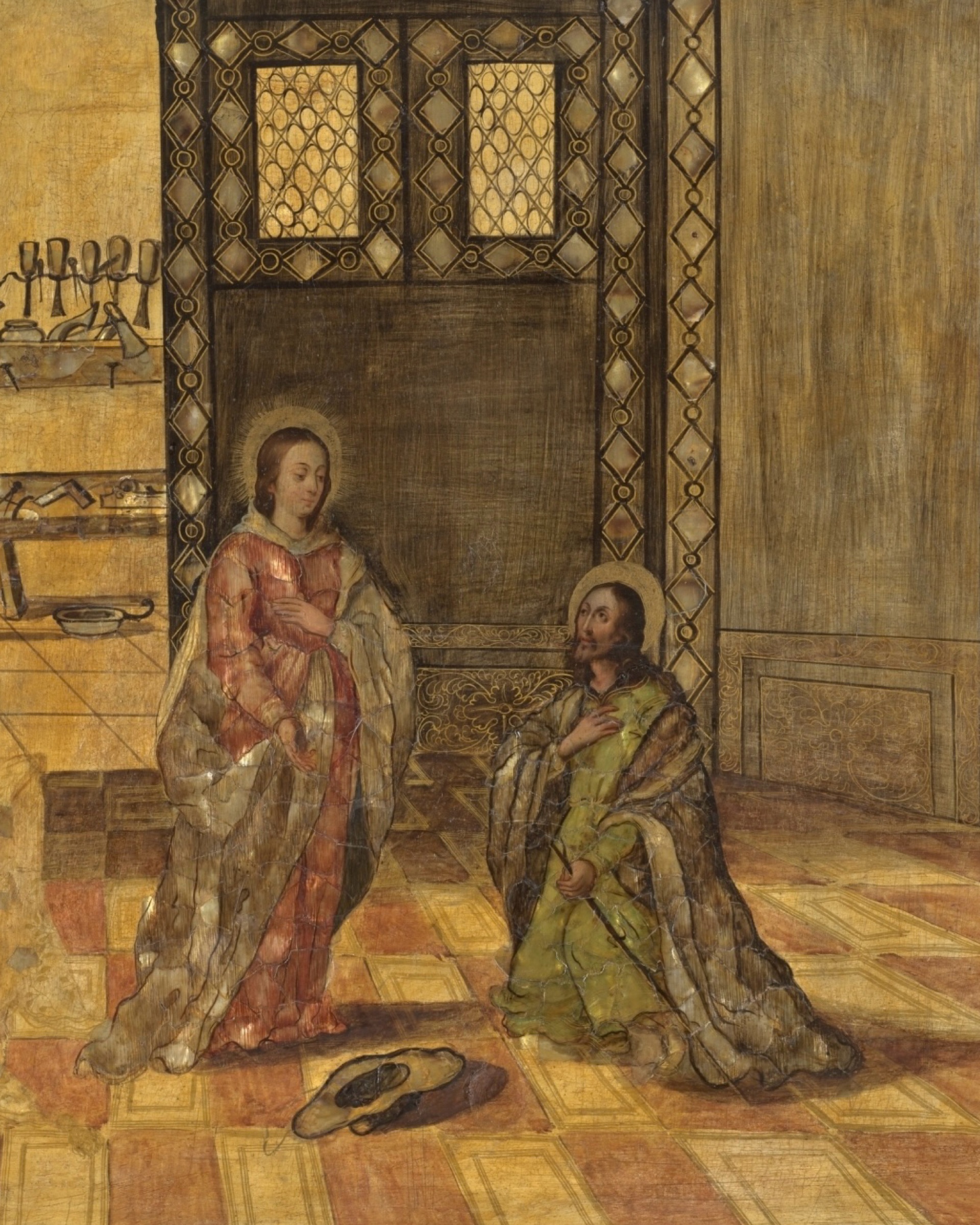
May is a month traditionally devoted to Mary, so how fitting that it should begin with the Feast of Saint Joseph the Worker, the silent witness of her purity and the bedrock of the Holy Family.
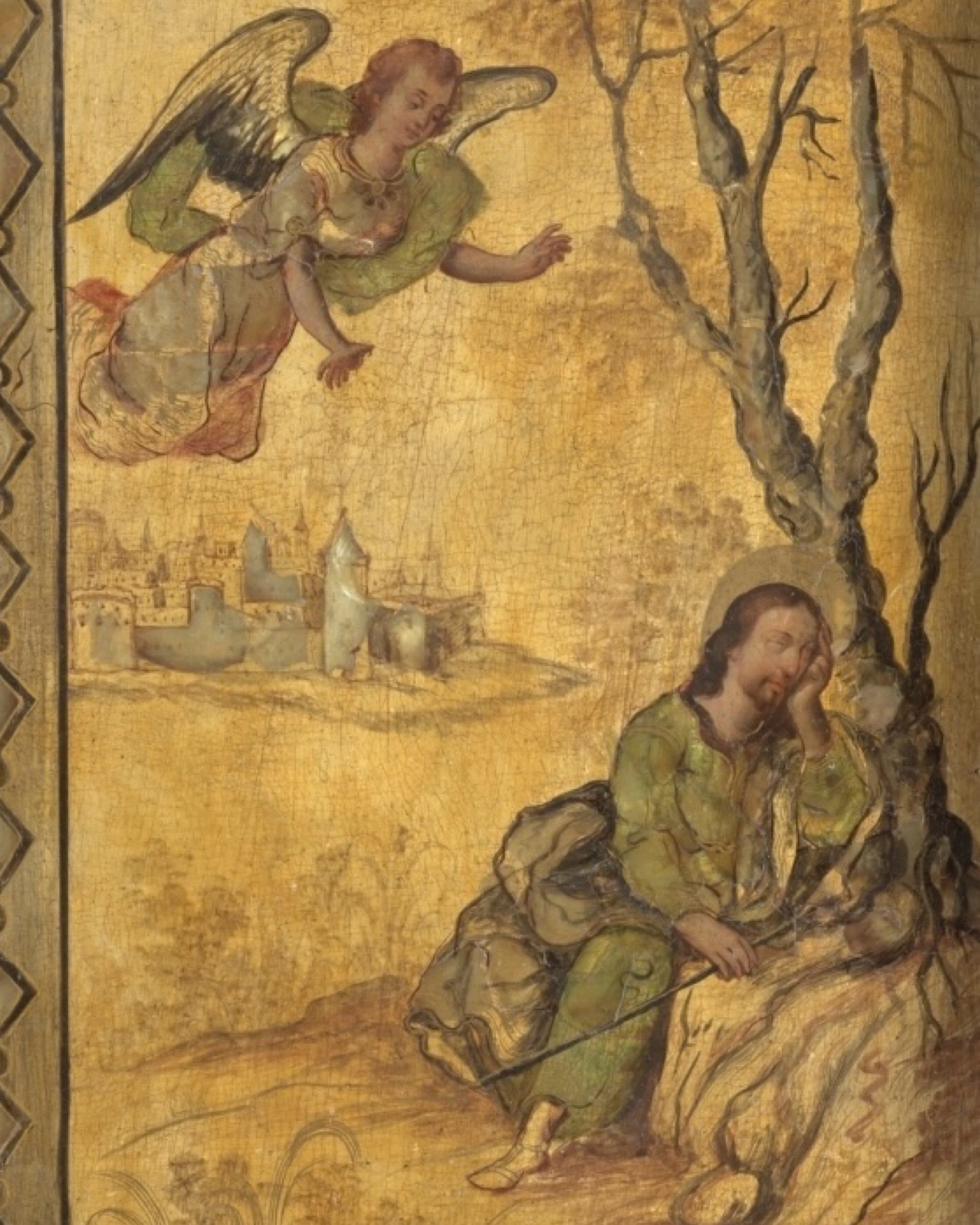
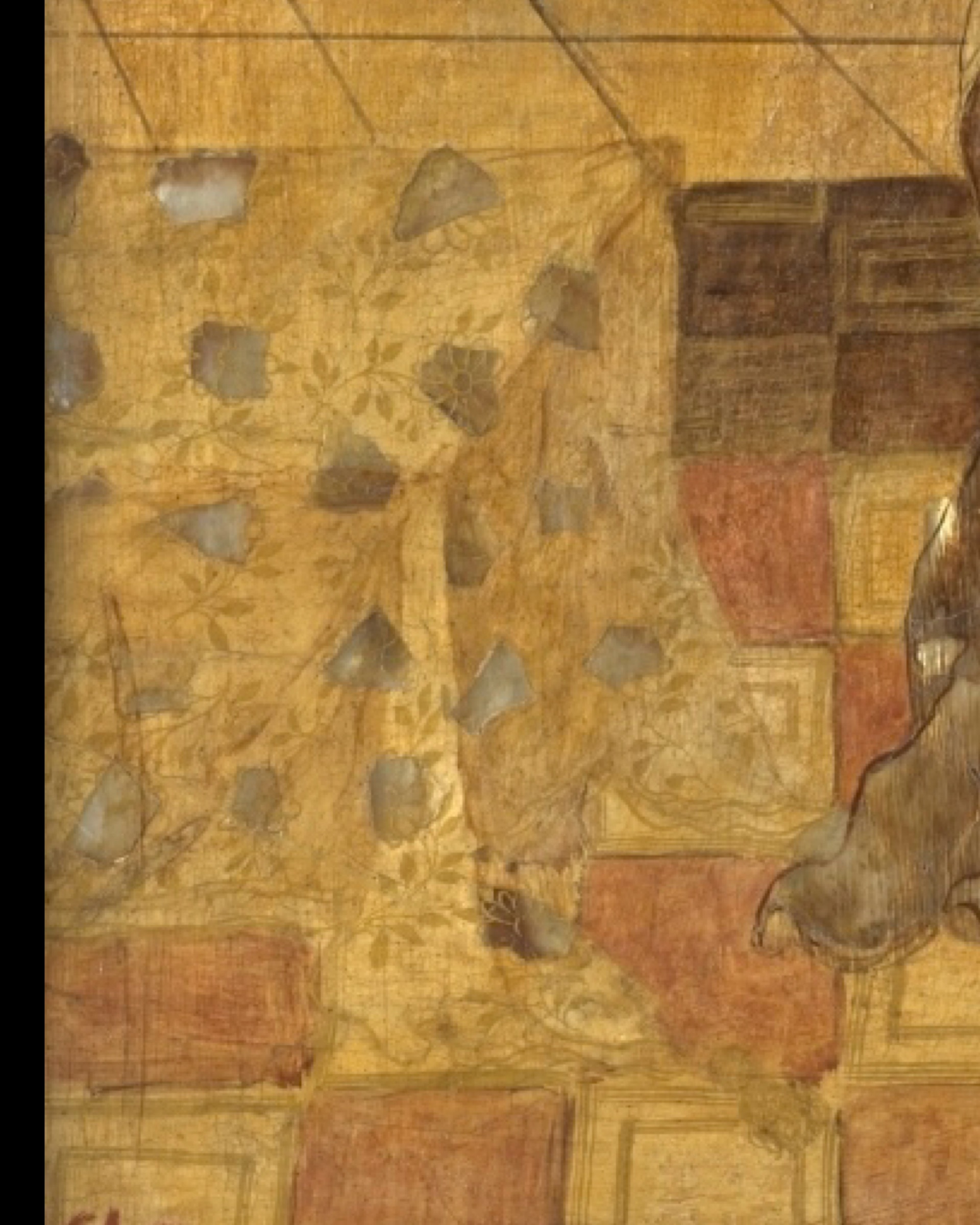
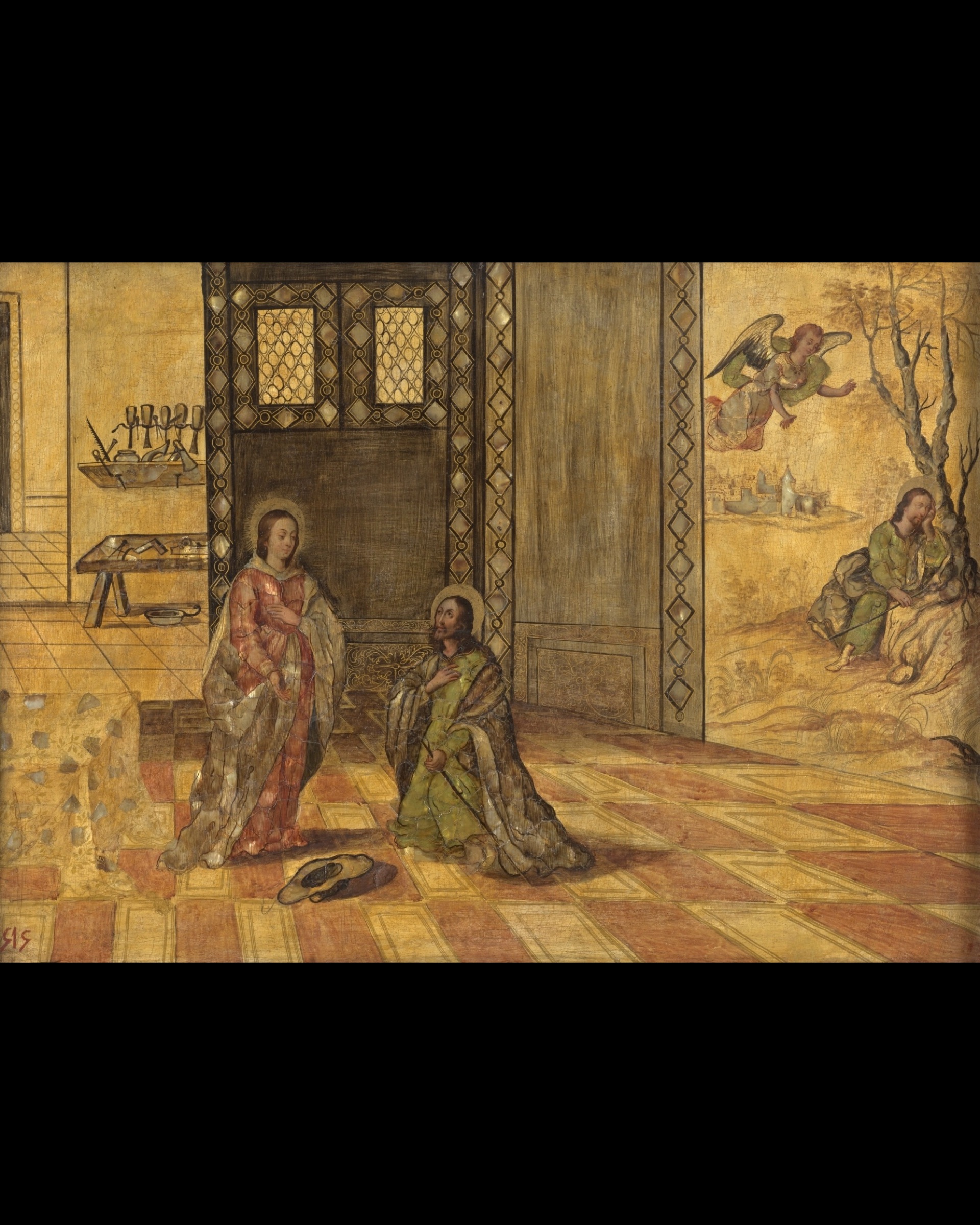
This 18th century image of Saint Joseph’s Dream and Repentance, made from shell and oil paint, comes from a series of six scenes dedicated to the Life of the Virgin. It recalls the episode from the opening chapter of Matthew’s gospel when Joseph discovered Mary was pregnant and considered sending her away, but ‘while he thought on these things, behold the angel of the Lord appeared to him in his sleep, saying: Joseph, son of David, fear not to take unto thee Mary thy wife, for that which is conceived in her, is of the Holy Ghost. And she shall bring forth a son: and thou shalt call his name JESUS. For he shall save his people from their sins’.
These panels called ‘enconchados’ were executed using a technique of Oriental origin, and were very popular in New Spanish culture, where local artists developed and espoused them as one of their distinctive products. Their characteristic gleam stems from a combination of inlaid sheets of mother-of-pearl and fine layers of oil paint.
🎨 Anonymous, Saint Joseph’s Dream and Repentance, XVIII century. Shell work on panel. The Prado, Madrid.
Bernat Martorell (active from 1427 to 1452), Saint George and the Dragon, c. 1434–35. Art Institute of. Chicago.
Depicted here, by the great Catalan artist Bernat Matorell, is the most frequently represented episode from the popular legend of Saint George, in which the model Christian knight saves a town and rescues a beautiful princess.
Here Saint George, on his white steed, triumphs over the evil dragon. A wealth of precisely observed details intensifies the drama. Dressed in an ermine-lined robe, the princess wears a sumptuous gilt crown atop her wavy red-gold hair. Her parents and their subjects watch the spectacle from the distant town walls. George’s halo and armor and the scaly body of the dragon are richly modeled with raised stucco decoration. Martorell also treated the ground, littered with bones and crawling with lizards, in a lively manner, giving it a gritty texture.
Conceived in the elegant, decorative International Gothic style, the painting was originally the center of an altarpiece dedicated to Saint George that was apparently made for the chapel of the palace of the Catalan government in Barcelona. This central scene was surrounded by four smaller narrative panels, now in the Musée du Louvre, Paris, and was probably surmounted by a lost image of Christ on the Cross.
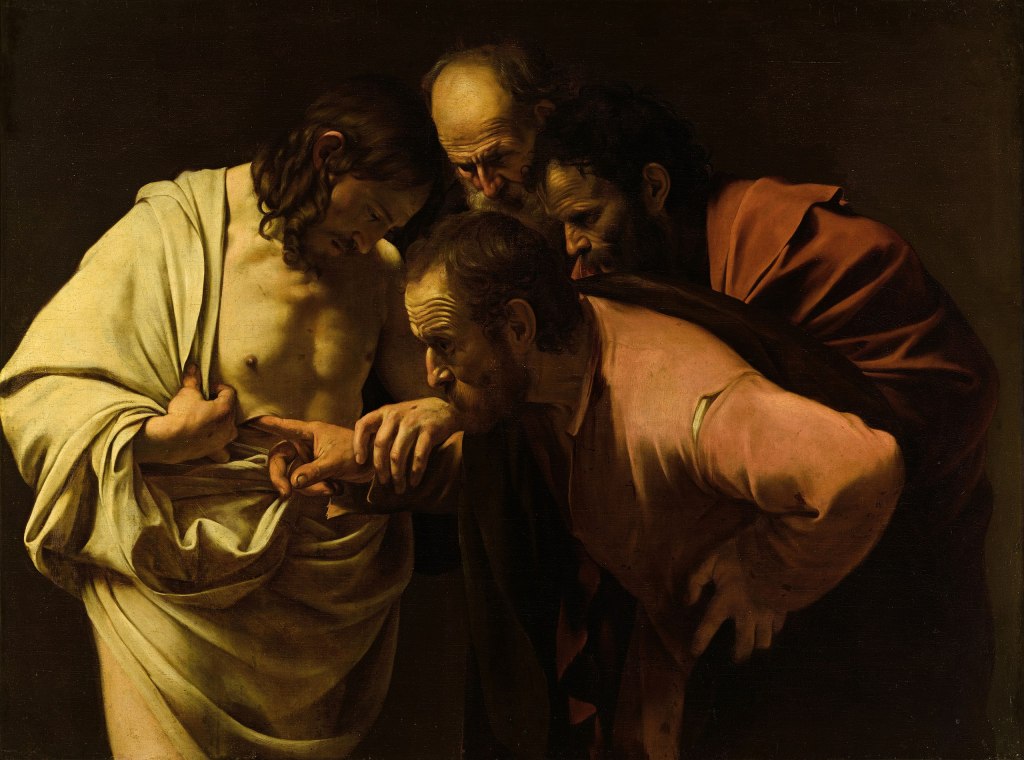
Michelangelo Merisi, called Caravaggio, The Incredulity of Saint Thomas, 1602. Schloss Sanssouci, Potsdam.
The Gospel of John tells us that ‘after eight days, again His disciples were within, and Thomas with them. Jesus cometh, the doors being shut, and stood in the midst, and said: Peace be to you. Then He saith to Thomas: Put in thy finger hither, and see My hands, and bring hither thy hand, and put into My side; and be not faithless, but believing. Thomas answered and said to Him: my Lord and my God. Jesus saith to him: Because thou hast seen Me, Thomas, thou hast believed; blessed are they that have not seen, and have believed.‘
In Caravaggio’s rendering of this scene we see in a demonstrative gesture how the doubting apostle puts his finger into Christ’s side wound, the latter guiding his hand. The unbeliever is depicted like a peasant, dressed in a robe torn at the shoulder and with dirt under his fingernails. The composition of the picture is such that the viewer is directly involved in the event and feels the intensity of the process.
Ever the master of light and shadow Caravaggio uses the light falling on Christ to emphasise his physicality and at the same time to suggest his divinity and significance to the viewer. By contrast, t shadows (representing doubt) sweep over St. Thomas, but as he touches Christ he is drawn into the light.
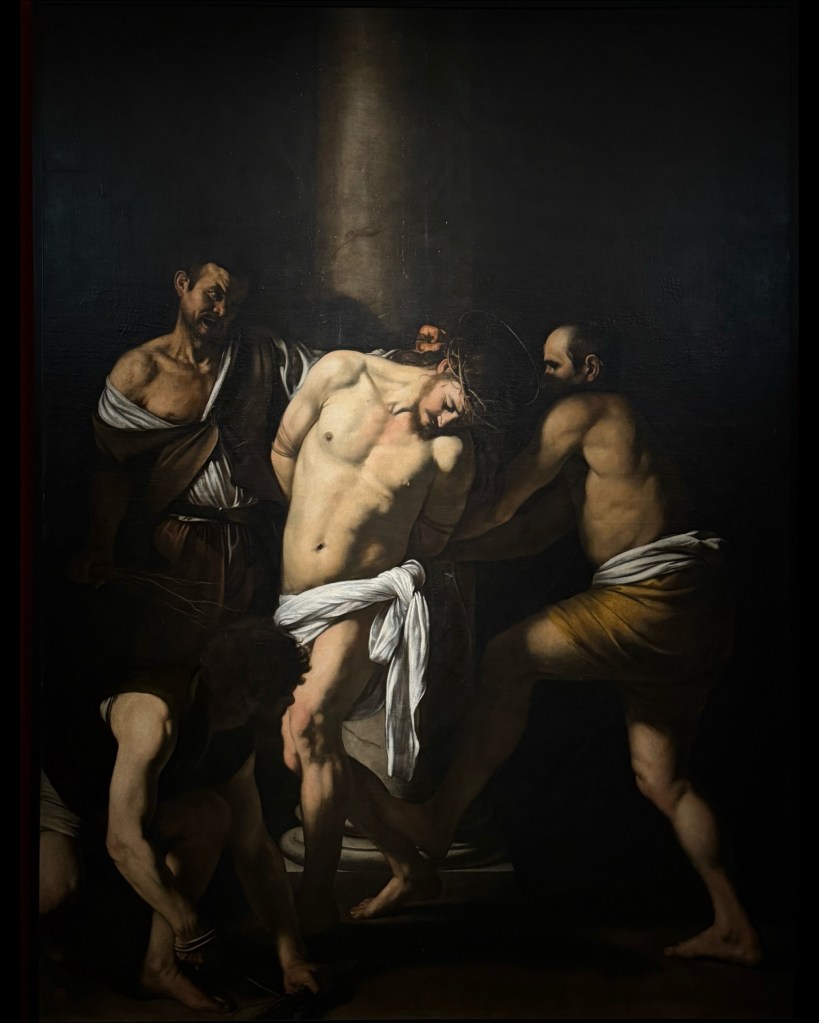
Michelangelo Merisi called Caravaggio, Flagellation of Christ, 1607. Museo e Real Bosco di Capodimonte, Napoli. Property of Fondo Edifici di Culto, Ministero dell’Interno.
The Flagellation of Christ is undeniably one of the most important canvases Caravaggio painted in Naples. Sources attest that it was indeed one of the paintings that sealed his success as a painter in the city. It is built around the stunning, sculptural figure of Christ, his body bathed in light and symbolically displayed.
The painting was commissioned in 1607 by Tommaso de Franchis as an altarpiece for the family chapel in the church of San Domenico Maggiore, initially positioned in the cloister. The painting, along with the chapel, were not moved into the church until much later in 1652.
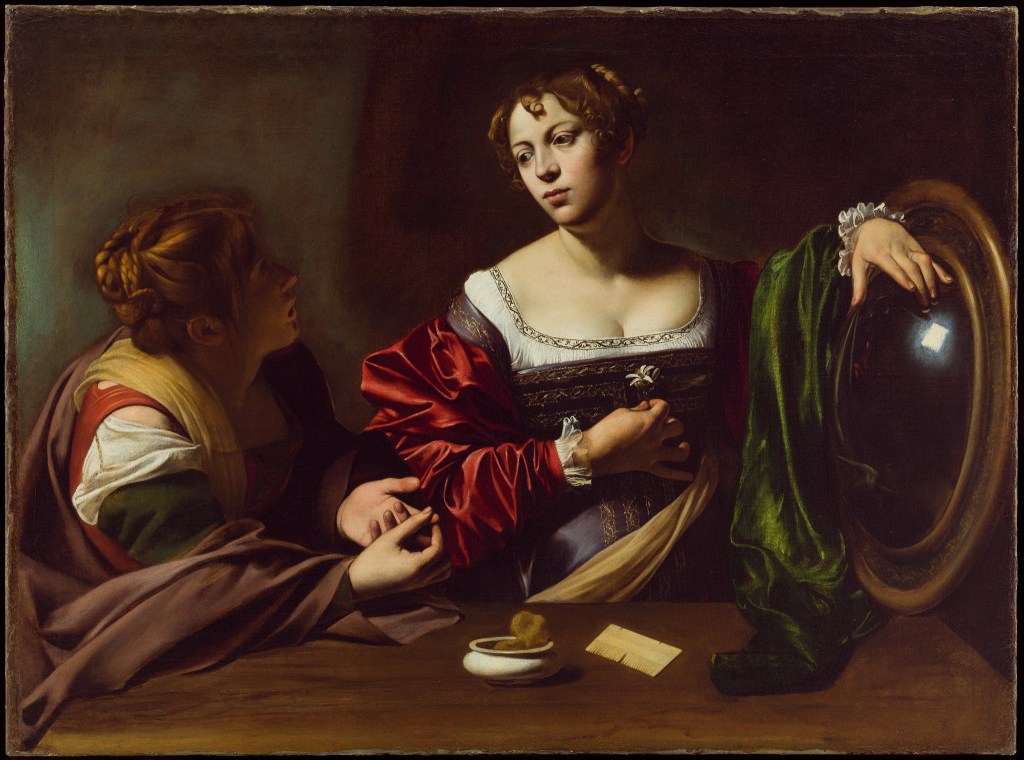
Michelangelo Merisi called Caravaggio, Martha and Mary Magdalene, c. 1598-1599. Detroit Institute of Arts, Detroit, Michigan.
This image, which Caravaggio may have painted for Olimpia Aldobrandini, takes as its starting point a passage from the Gospel of Luke in which Christ has been welcomed into the house of sisters Martha and Mary Magdalene. It shows an imaginary exchange between the modest Martha, shown reproaching her sister for her wayward conduct and enumerating on her fingers the miracles of Christ, and the sensual, vain Mary, who wears luxurious clothing and rests her hand on a large mirror.
However, Caravaggio introduced details that hint at Mary’s forthcoming conversion. In her right hand, she holds an orange blossom twig, a symbol of purity; the ring on her left hand alludes to her status as the bride of Christ. PThe lavishly attired Mary Magdalene is caught in a moment of reflection, resting her hand on a convex mirror. The mirror may be a reference to the ‘mirrored shield’ used by Caravaggio in his artistic practice and recorded in the 1605 inventory of his goods.
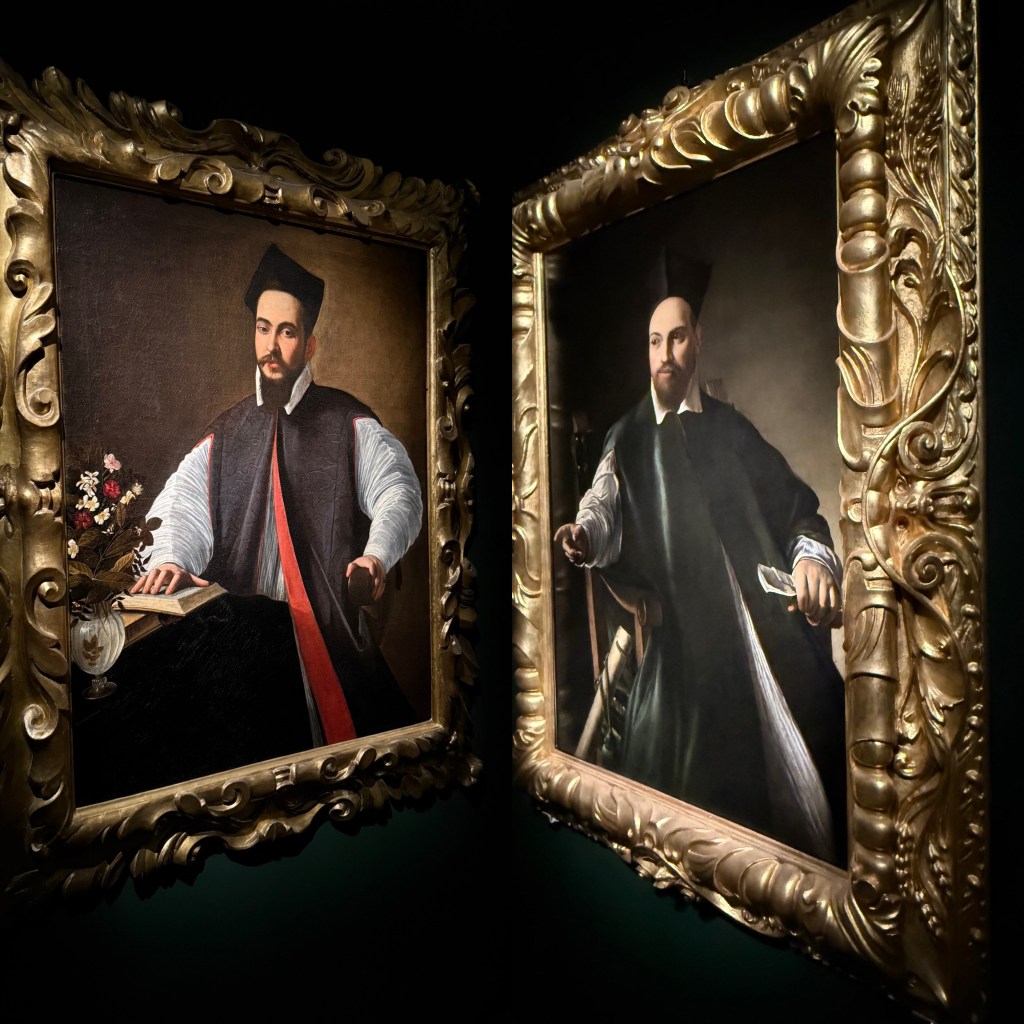
This extraordinary painting on the right, first published by Roberto Longhi in 1963, is one of the few surviving portraits by Caravaggio. The sitter is Maffeo Barberini, an important prelate of the Roman curia who became pope as Urban VIlI in 1623. In his lefthand, he clutches a piece of parchment which probably bears the decree appointing him Cleric of the Apostolic Chamberin 1597 while his right arm points to something beyond the canvas, invades the space of the viewer and brings us into a direct relationship with the personality of the sitter.
This painting, on public display for the very first time, represents a benchmark for all seventeenth century portraiture and one ofthefinest examples of this genre.
The painting on the left, whose attribution to Caravaggio has always been debated by scholars, is also a portrait of Maffeo Barberini. What we know for certain is that Maffeo, who had an avid interest in all manner of arts and culture, commissioned Caravaggio to do another painting between 1603 and 1604, generally recognised by critics as the stunning Sacrifice of Isaac from the Uffizi Gallery in Florence.
🎨 Left: Michelangelo Merisi called Caravaggio, attributed, Portrait of Monsignor Maffeo Barberini as Protonotary Apostolic, c. 1595. Private collection, Firenze. 🎨 Right: Michelangelo Merisi called Caravaggio, Portrait of Maffeo Barberini, c. 1598-1599. Private collection.
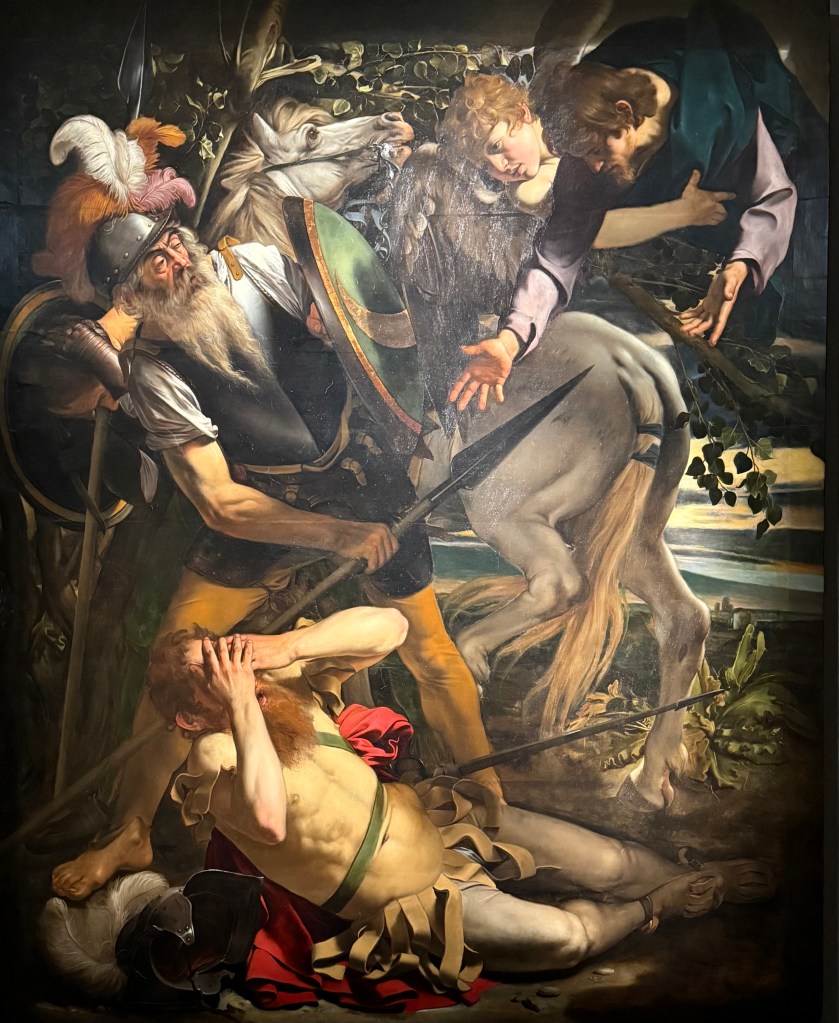
Michelangelo Merisi called Caravaggio, Conversion of Saul, 1600-1601. Nicoletta Odescalchi collection, Rome.
With mourners, pilgrims and tourists gathering in Rome at this time, I hope many will also find the time to visit Caravaggio 2025, the landmark exhibition of 28 works by the baroque master brought together as the artistic highlight of this Jubilee year.
While many of the works are usually at home in Rome’s museums, the joy of this exhibition is seeing a number of works from private collections and US institutions, including this stunning image of the Conversion of Saint Paul (Saul) from the Nicoletta Odescalchi collection.
In 1600 Tiberio Cerasi asked Caravaggio for two paintings: the Crucifixion of Saint Peter and the Conversion of Saul for his chapel in Santa Maria del Popolo in Rome. When Caravaggio obtained the commission, the chapel had not been built yet, so it was impossible for him to know what the space would be like. The first version Caravaggio painted of the two religious episodes on precious cypress panels was in fact ill-suited to the chapel’s narrow, cramped structure, so Caravaggio had to repaint both episodes, which we are still able to admire in the church today. Unfortunately, the initial version of the Crucifixion of Saint Peter was lost, whereas, fortunately this magnificent Conversion of Saul was conserved.
Benedetto Rabuyate (1507-1592) and Gaspar de Palencia (c. 1531-1590), Altarpiece of The Resurrection, c. 1570, Oratory of the Court of the Royal Chancellery, Valladolid.



 The Arts of Golden Age Spain and the Hispanic World