Artists and philosophers have long struggled with questions of what art is for and how it shapes our experience as viewers. When it comes to sacred art the answers to these questions may seem more obvious, for here an artwork is usually required to illuminate some aspect of our faith and spark in us a devotional and prayerful response. Many will recognise the feelings of sorrow, grief and possibly even guilt when we look upon an image of Jesus suffering on the cross. Likewise, when confronted with paintings of Christian martyrs we may experience in our own bodies a sense of their pain and anguish, in a similar manner to the empathy we feel for the pain of others in our daily lives as we visit family who are sick or watch the never-ending human tragedies that dominate the nightly television news. Yet, for all that art can hold a mirror to the more painful aspects of our lives, the more challenging emotions to depict in paint or stone are surely the brighter but less tangible feelings of joy, love and most especially hope.
As an art historian my working days are spent trying to understand how works of art were created and how they speak to those, both past and present, who encounter them. However, even with a trained eye I cannot hide the difficulty in seeing hope, an emotion that is both intensely internal and individual. Our personal hopes and dreams are as unique as the pattern of our eyes or the lines on the palms of our hands. Hope also inevitably points toward a future state of being that is distinctly better than our current life. To portray this ineffable emotion, artists must therefore deploy the cleverest of techniques and pictorial strategies to reveal something so hidden in the human heart, producing artworks that are capable of engaging the viewer in both our present reality and our desires for what it yet to come. Here the makers of Christian art may have an advantage over their purely secular counterparts, for the Church has long held that the highest purpose of religious art is to use the artist’s God given talents to direct the beholder towards events and beliefs whose meanings lie quite rightly beyond our material world. As the writer of Ecclesiastes so eloquently explains, ‘He has made everything beautiful in its time. Also, he has put eternity into man’s heart, yet so that he cannot find out what God has done from the beginning to the end.’ (Ecclesiastes 3:11). Whether through painting, sculpture, music, or literature, sacred art should therefore transcend barriers and open windows to a world where hope is not only visible but tangible.
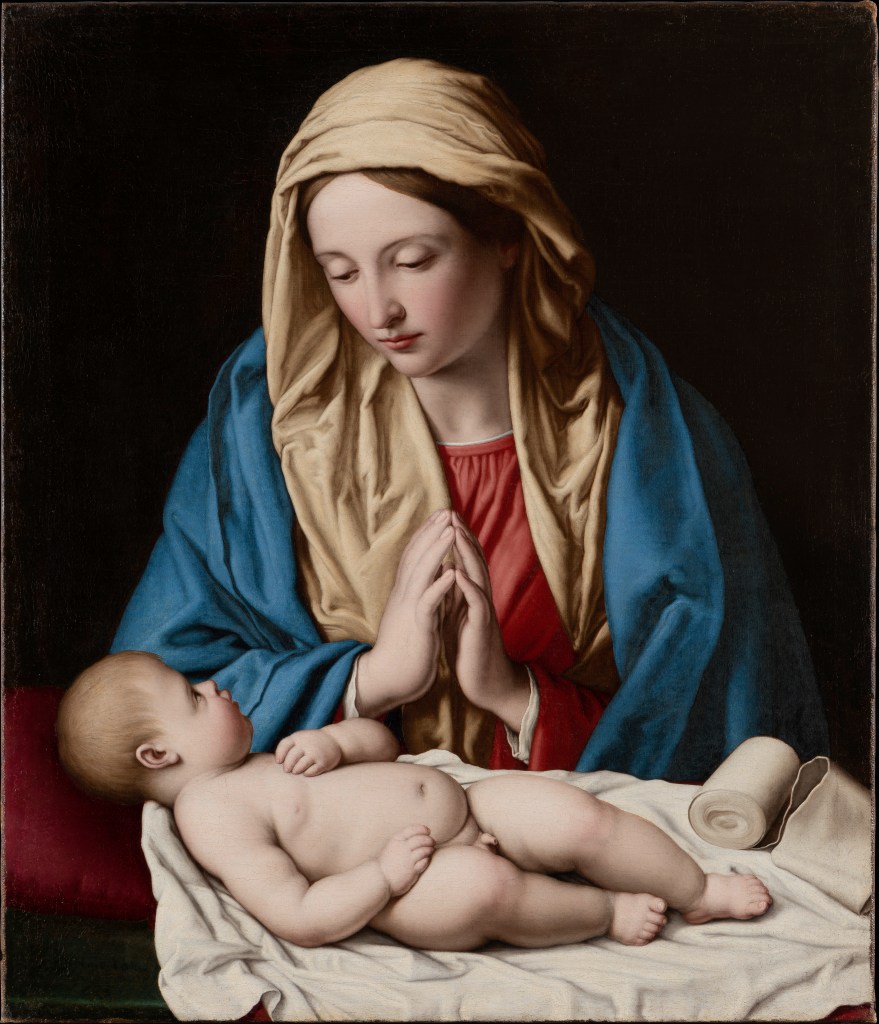
One painting that for me encapsulates this potential of quite literally seeing hope is this image of Mary worshiping the Christ Child by the Italian seventeenth century artist Giovanni Battista Salvi, better known as Sassoferrato (1609-1665). Here the artist depicts the Virgin Mary in quiet adoration of the Christ Child, who is resting on a white cloth before her. The Virgin’s hands are clasped in prayer, her head inclined with a gentle, contemplative expression. Sassoferrato emphasizes Mary’s purity and devotion through the soft, unblemished features of her face set against the vivid ultramarine of her cloak. The Christ Child is painted with a tender realism, his posture exuding innocence and vulnerability, while the interplay of light and shadow highlights the sacred intimacy between mother and child. Sassoferrato’s deliberate use of smooth textures and vibrant colours creates a luminous, almost otherworldly quality. A restrained approach, focusing on stillness and devotion that invites the viewer to meditate on the divine mystery of the Nativity
One of art’s most profound abilities is to remind us of the extraordinary beauty in the ordinary, and nothing can be more familiar than the relationship between a mother and her child. In Sassoferrato’s painting we see clearly that most intimate bond of a mother’s unconditional love and a child’s total trust and dependence. A tender moment in which Mary is the Christ Child’s whole world. An image that fosters hope through its connection to our shared humanity. An encounter through the medium of paint that echoes our own struggles or joys, and a reminder of that moment when looking into our own mother’s eye we realised that we are not alone. A sense of belonging that is profoundly hopeful.
One detail of Sassoferrato’s painting that might easily be missed is the neatly rolled up piece of cloth lying by the Child’s feet. At first glance this may appear as a swaddling cloth, that will soon be used to clothe the naked infant’s body. Yet as we dwell on this perfectly depicted object our thoughts may well be cast forward to the clothes that Mary will use some years in the future to wrap her dead son as he is taken down from the cross. The cloth witnessed by Simon Peter as he entered the empty tomb ‘that had been on Jesus’ head, not lying with the linen wrappings but rolled up in a place by itself’ (John 20:7). A simple roll of linen transformed into the greatest symbol of our Christian hope.
Ultimately, the hope found in art lies in its affirmation of life’s depth and potential. It speaks to our resilience, creativity, and capacity for joy even in the darkest times. By engaging with art, we find reminders of both God’s grace in our own lives and glimpses of a world worth striving for—a world, both present and future where hope persists, radiant and unyielding.
(This article appears in ‘Hope Springs Eternal’, compiled by Daniel P Cronin and published by St Paul’s Publishers, London. ISBN:9781910365939)
 The Arts of Golden Age Spain and the Hispanic World