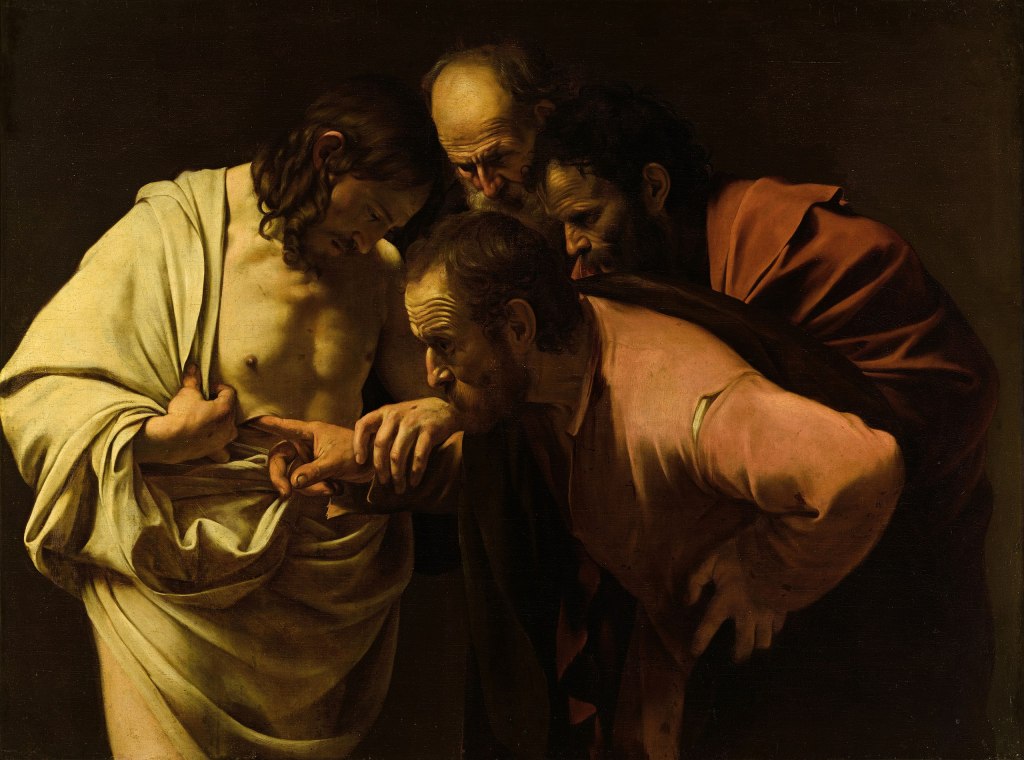
The Gospel of John tells us that ‘after eight days, again His disciples were within, and Thomas with them. Jesus cometh, the doors being shut, and stood in the midst, and said: Peace be to you. Then He saith to Thomas: Put in thy finger hither, and see My hands, and bring hither thy hand, and put into My side; and be not faithless, but believing. Thomas answered and said to Him: my Lord and my God. Jesus saith to him: Because thou hast seen Me, Thomas, thou hast believed; blessed are they that have not seen, and have believed.‘
In Caravaggio’s rendering of this scene we see in a demonstrative gesture how the doubting apostle puts his finger into Christ’s side wound, the latter guiding his hand. The unbeliever is depicted like a peasant, dressed in a robe torn at the shoulder and with dirt under his fingernails. The composition of the picture is such that the viewer is directly involved in the event and feels the intensity of the process.
Ever the master of light and shadow Caravaggio uses the light falling on Christ to emphasise his physicality and at the same time to suggest his divinity and significance to the viewer. By contrast, t shadows (representing doubt) sweep over St. Thomas, but as he touches Christ he is drawn into the light.
 The Arts of Golden Age Spain and the Hispanic World