For one day the penitential character of Lent is lightened with the celebration of the Feast of the Annunciation, the first great act of Salvation History.
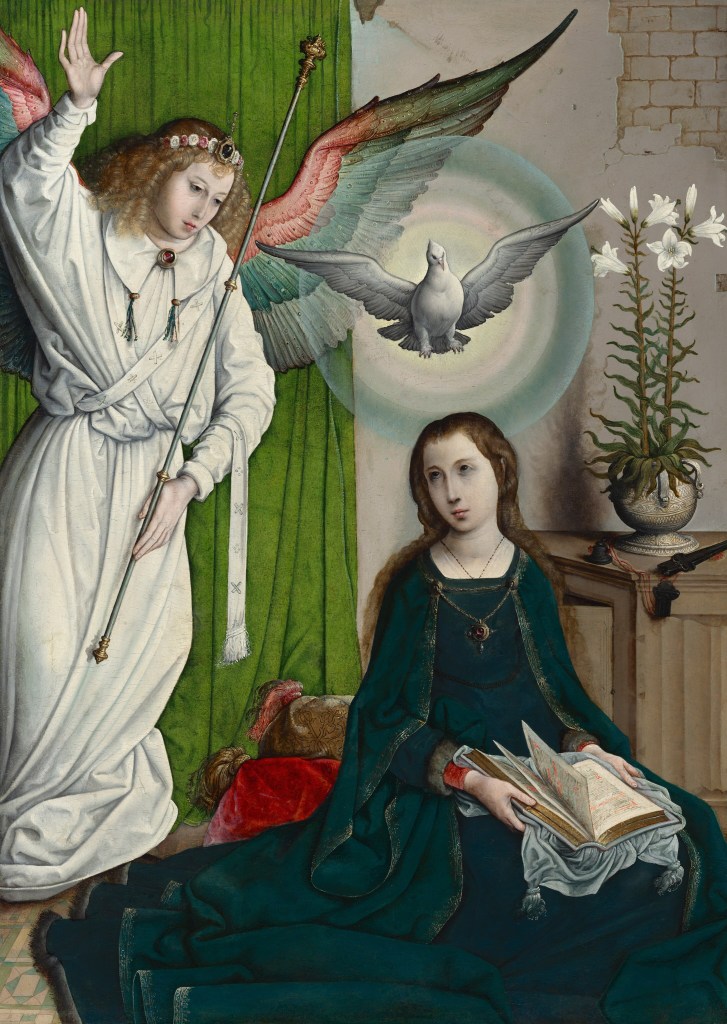
In this crowded image of the event, by the Hispano-Flemish artist Juan de Flandres, the youthful Virgin sits on a crimson tasseled cushion, wearing a voluminous, long, royal-blue dress, her garment edged in fur and gold, an indication of her future Royal status.
A winged angel stands looking at Mary with one arm raised as if in blessing, while in the other arm the angel holds a long, gold staff, a symbol of heavenly authority. Overshadowing the Virgin the Holy Spirit in the form of a white dove hovers with wings outstretched, surrounded by a white halo deepening in several concentric rings to aquamarine blue. The halo could belong to the dove or the Virgin, a physical sign of the union between God and humanity that it is at the heart of the annunciation message.
Last, we see a bright emerald-green cloth hanging on the cream-white wall behind the angel, and brick shows through what appears to be lost plaster over the woman’s head to our right. The door of a cabinet behind the woman is ajar and a rounded urn holding tall, white lilies sits on the surface above. A rich symbolic passage demonstrating how the purity of Mary will overcome the decay of the human of the race.
 The Arts of Golden Age Spain and the Hispanic World