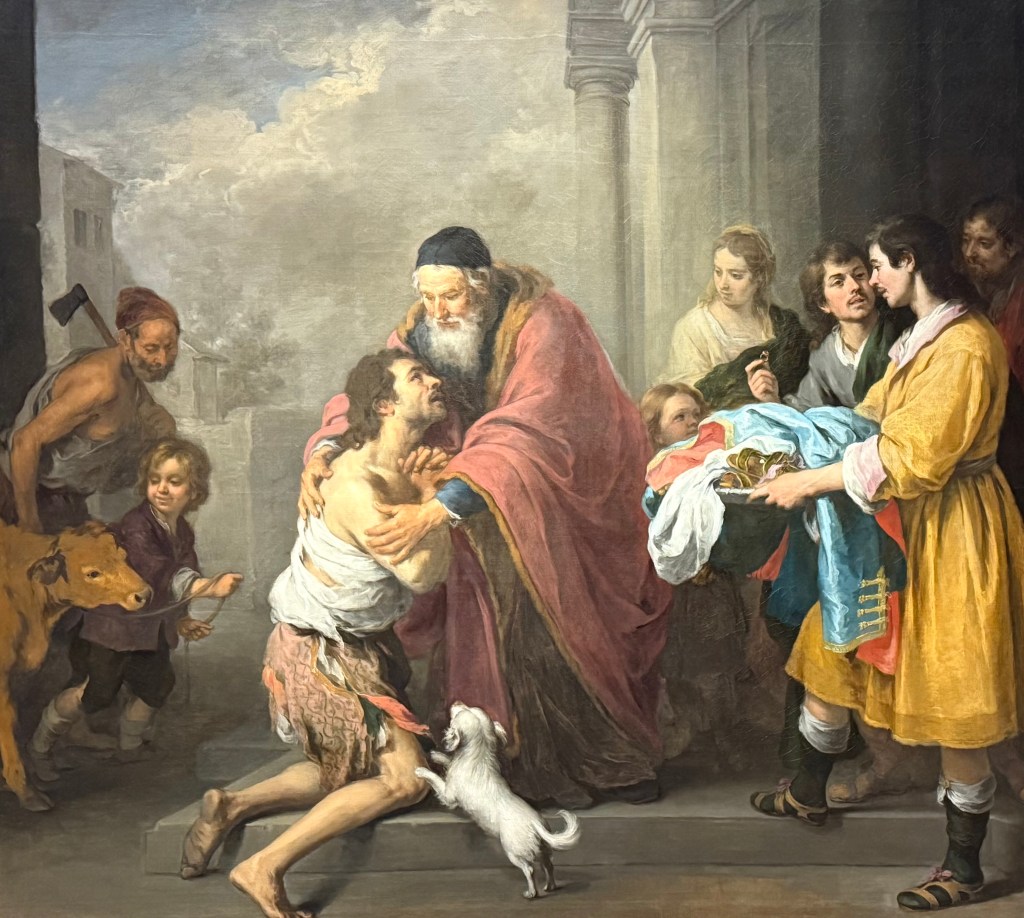
Murillo’s rendering of the parable of the prodigal son, taken from Luke’s Gospel (15:11-32) is surely one of the most tender and compelling illustrations of forgiveness and unconditional love. A younger son squanders his inheritance and having reached rock bottom returns home repentant, only to find himself welcomed home with joy in the warm embrace of his father, who immediately sends for new clothing and a fatted calf to celebrate this happy moment. The only sad note in the story is the older son’s resentment, who Murillo portrays as a downcast, axe bearing labourer, a symbol of our human struggle with jealousy despite the boundless nature of divine mercy.
The work is one of eight paintings commissioned for Seville’s Hermandad de la Caridad, to which the artist himself belonged and one of whose commandments was to clothe the naked. Four of those eight works remain in Seville (The Miracle of the Loaves and Fishes, Moses at the Rock of Horeb, Saint Elizabeth of Hungary and Saint John of God Carrying a Sick Man), whereas this work and the other three (The Healing of the Paralytic, Abraham Receiving the Three Angels and The Liberation of Saint Peter) were looted by Napoleon’s army in 1810 and can now be seen in London, Ottawa and Saint Petersburg.
 The Arts of Golden Age Spain and the Hispanic World