Today is the Feast of Saint Thomas Aquinas (c. 1225 – 7 March 1274) the Dominican friar and priest, and one of the most influential philosophers and theologians in the Western tradition.
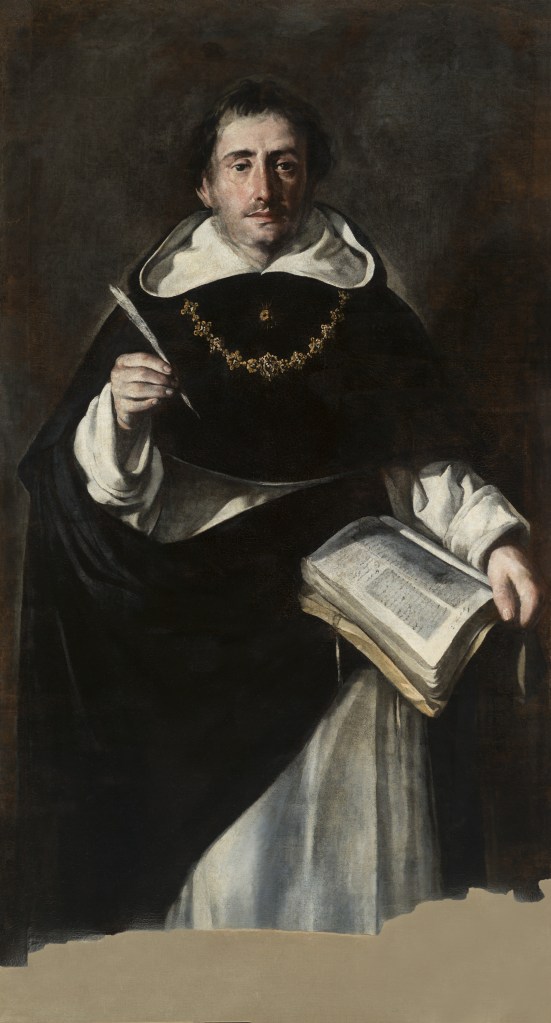
Thomas was born in Roccasecca, near Aquino, controlled then by the Kingdom of Sicily, and in this portrayal of the saint by Antonio del Castillo y Saavedra (1616 – 1668) Thomas stands with his pen raised as if he is ready to write, perhaps his famous ‘Summa’ – judging by the size of the large book at his side. As if to emphasise Dominican balance between study and contemplation Thomas appears to have paused his intellectual activity as if he is waiting to receive divine illumination.
Castillo introduces all the attributes necessary to identify the saint, in particular the black and white habit of the Dominicans, the gold chain related to his “Catena aurea” and the small sun on his chest, a pictogram of Pius V’s declaration referring to the saint as “the brightest light of the Church”.
Castillo’s Thomas is given a highly individual appearance, with a long nose and full lips framed by a small moustache, suggesting the artist used a life model. Possibly, the model was chosen for his strong build and short neck, which is in keeping with Saint Thomas’s nickname, the Sicilian ox, acquired during his student days in Cologne.
This work would originally have been the same size as a companion piece of Saint Bonaventure, but it was probably cut down to eliminate damage caused by the damp in the convent where it spent much of its life, and Saint Thomas lost his legs below the knee.
 The Arts of Golden Age Spain and the Hispanic World