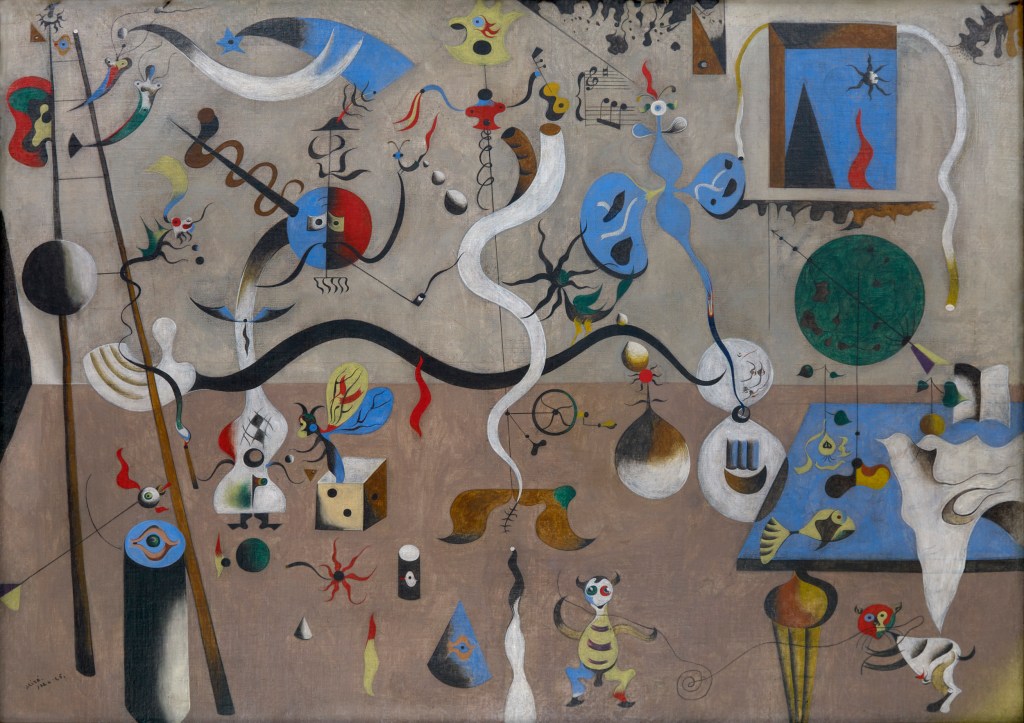
With the Carnival season about to reach its climax, here is The Harlequin’s Carnival by Catalan artist Joan Miró (1893-1983).
In 1924, poet André Breton formed the Surrealist movement, around the time Miró started to focus on dreams and the subconscious as artistic material, fused with his own life experiences and memories.
Created between 1924 and 1925, Miró’s harlequin resembles a guitar, yet he still retains some of his harlequin characteristics such as a checkered costume, a mustache, an admiral’s hat, and a pipe. However, the harlequin in this painting is sad, which could be due to the hole in his stomach, a detail that may refer to Miró’s personal life experiences as he had little money for food and was on the brink of starvation.
Overall this is a painting of a celebration; all the characters seem to be happy due to the fact they are playing, singing, and dancing. Some of the objects in the painting are anthropomorphized, for example the ladder to the left of the painting, which has an ear and an eye. According to Miró, the ladder is a symbol of flight, evasion, and elevation. The cat in the bottom right of the painting represents Miró’s actual cat, who was always next to him as he painted.
The painting includes many other fantastical and magical elements such as mermaids, fish out of water, dancing cats, shooting stars, a creature with wings in a box resembling a dice, floating musical notes, and a floating hand, all contributing to a magical atmosphere within this composition.
 The Arts of Golden Age Spain and the Hispanic World